We may earn a commission when you purchase through our affiliate links, at no extra cost to you. This helps support our work and allows us to continue providing unbiased, expert diamond advice.
Note: Most prices, product details, or comparisons mentioned in this article are based on information available from our trusted partner we frequently reference: Blue Nile. We may earn a commission when you purchase through our affiliate links, at no extra cost to you. This helps support our work and allows us to continue providing unbiased, expert diamond advice.
The princess cut is a square stone carrying the light engine of a round brilliant inside it, which is exactly why it looks so modern on the hand and so awkward beside the wrong band.
Hillary Duff, Star Jones, and Kate Bosworth have all worn one. It is a great choice.
What you want from the wedding band is simple: it should support the center stone and add to its brilliance, never compete with it. Straight lines next to straight lines, in the same metal, with no daylight in the gap.
Wedding bands for a princess cut, in a few lines:
- A straight, flat-profile band that sits flush against the ring is the default match, and it works with most 4-prong and V-prong princess solitaires with no custom work at all.
- Channel-set bands holding square or baguette stones echo the 90-degree corners of a princess cut far better than round accents do.
- You only need a curved or notched band when a halo, cathedral shoulders, or a low-sitting head physically blocks a straight one.
- Metal match beats brand match: two different metals pressed against each other for years scratch and wear at different rates, and it shows.
- The 4 corners are the weak point of a princess cut, so a band that sits flush also shields the two corners nearest to it.
Table of Contents
Toggle
What Wedding Band Goes Best With a Princess Cut Engagement Ring?
A straight band with a flat profile, sitting flush against the engagement ring. The princess cut lives on square corners and clean lines, so a band with the same straight edge reads as one ring instead of two competing ones. Curved and notched bands only earn their place when the setting blocks a straight band from meeting it.
That is the default, and defaults exist for a reason.
In twelve years of pairing bands for readers, we’ve found the straight band fails on exactly one kind of ring: the one whose head or halo sits so low over the finger that nothing flat can slide up and touch it. Everything else on this page is preference, not necessity.
Before you commit, feel free to browse the wedding bands collection at Blue Nile with your own engagement ring in front of you, and look at the edge where the two rings will touch rather than at the sparkle.
If the vocabulary is still fuzzy, our guide to the difference between an engagement ring and a wedding ring covers who wears what, and when.
How Do You Choose a Band That Sits Flush?
Hold the band against the engagement ring and look at the gap. If light shows between the two at any point, the pair will rock, spin, and rub each other thin over the years. Once the gap passes, check three things in this order: metal, profile height, and the size of the accent stones.
1. The Gap Test
Press the two rings together on a flat surface and look from the side, not from above. A flush pair touches along its whole contact line; a bad pair touches at one point and gaps at the others.
Spinning is the symptom everyone reports later. The gap is the cause.
2. Metal First, Style Second
Same metal, same alloy where you can manage it. Platinum against 14k white gold looks identical on day one, then the platinum burnishes and the gold’s rhodium plating wears, and by year two you can see which is which.
Some readers deliberately mix metals for contrast, and that is a valid look; just choose it on purpose. If you are undecided, our guide to the best ring metal for an engagement ring lays out the trade-offs.
3. Accent Stone Size
Accent stones on the band should be visibly smaller than the center stone. When they creep up in size, the eye stops reading a set and starts reading two engagement rings on one finger.
4. Width and Profile
Match the band width to the shank of the engagement ring, or go slightly narrower. A band wider than the shank makes the princess cut look smaller than it is, which is a strange thing to pay for.
Now the styles themselves.
7 Wedding Band Styles That Work With a Princess Cut
Seven styles pair well: classic straight, channel-set, pavé, curved, eternity, baguette, and milgrain or filigree. Straight and channel-set suit the square shape itself; the other five are chosen for the setting around the stone, or simply for the look you want on the hand. Here is what each one actually does.
1. Classic Straight Bands
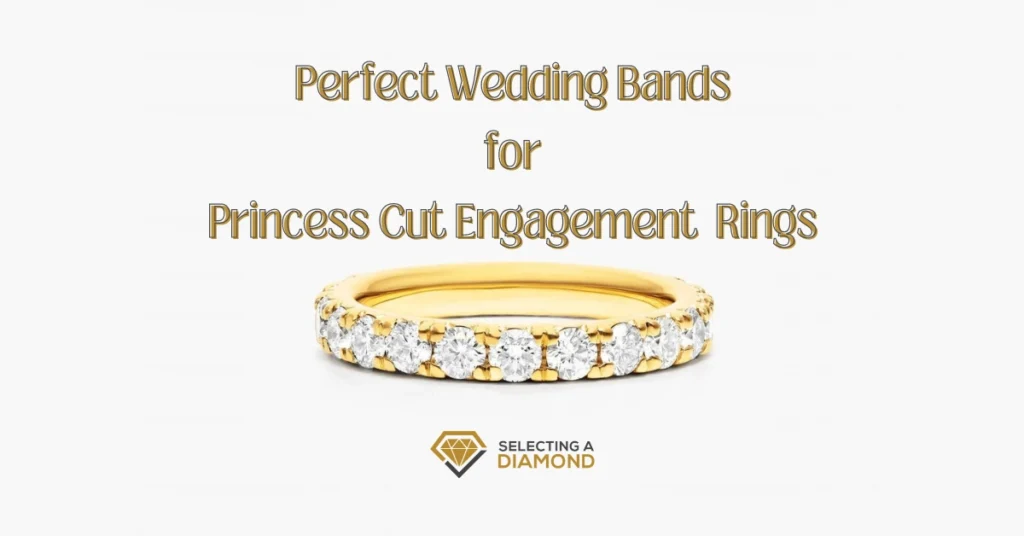
A straight band without any curvature sits flush against most princess cut engagement rings and disappears into the design in the best way. It is the most versatile choice on this list, and it is the one we recommend when a reader sends us a photo of a plain solitaire.
2. Channel-Set Bands
Channel-set bands hold small stones between two metal walls, with no prongs breaking the line. That flat, continuous top edge mirrors the geometry of the princess cut, and the walls protect the accent stones from knocks.
Straight and channel-set bands sit in the same range, so feel free to compare a plain straight band and a channel-set band at the same width before you decide.
3. Pavé Bands
Pavé sets small stones closely together across the surface, giving continuous sparkle beside the brilliance of the princess cut. It is softer and busier than channel setting, and it flatters a ring that already has pavé on the shank.
4. Curved (Contoured) Bands
If the setting of your princess ring extends out or drops low, a contoured band curves around it and closes the gap. Contoured bands are sometimes described as a universal fit. They are NOT: a contour is cut for a particular silhouette, so it has to be matched to your ring, not to the shape in general.
5. Eternity Bands
Diamonds run the full circumference, which looks superb next to a princess cut and symbolises the obvious thing. One practical catch, and it matters: a full eternity band cannot be resized, so your finger size has to be settled before you buy.
6. Baguette Bands
Baguettes are long, straight, step-cut rectangles, and their clean lines answer the angular lines of a princess cut better than any round stone does. If the shape is new to you, here is what a baguette diamond is and how it behaves.
7. Milgrain and Filigree Bands
If your princess ring carries vintage detailing, a band with milgrain beading or filigree work extends that antique language across both rings. On a stark modern solitaire, the same band fights the ring rather than joining it.
Tip: The corners of a princess cut are its most vulnerable points, which is why good settings use V-prongs to cap them. A band that sits flush against the ring adds a second layer of protection to the two corners closest to it.
What Wedding Band Works With a Solitaire Princess Cut?
A plain straight band, in the same metal, at roughly the same width as the engagement ring shank. A solitaire has nothing else competing for attention, so the band either vanishes into the design or hijacks it. If you want sparkle beside the stone, a half-eternity with small round pavé keeps the center stone clearly dominant.
Solitaire settings are also the ones that take a stacked pair happily, one band on each side of the engagement ring.
Symmetry is the reason it works: the center stone stays in the middle of the stack and never drifts to one edge of the finger. If you are weighing the order of your rings, we walk through how to wear a wedding band and engagement ring together on the same hand.
Should Your Wedding Band Have Princess Cut Diamonds Too?
It can, and channel-set princess accents echo the center stone’s corners in a way round melee never quite manages. The risk is scale: princess accents that approach the center stone in size turn the pair into two engagement rings. Keep the accents visibly smaller, keep them channel-set, and keep those tiny corners covered.
Shared-prong princess bands leave the accent corners exposed at the edge of the metal. Channel walls do not, and that is the practical difference between a band that survives a decade of daily wear and one that keeps going back for repairs.
We found princess-set and round-set bands sitting side by side in the same range, so it is worth putting both on the finger; you can compare them in the wedding rings selection at Blue Nile.
Which Band Fits a Halo, Three-Stone, Cathedral or Split Shank Princess Setting?
Halo and cathedral settings usually call for a contoured or notched band, because the halo edge or the raised shoulders stop a straight band from reaching the ring. Three-stone princess rings often take a straight band with no trouble at all. Split shanks are the fussiest: match the split, or stay plain.
1. Halo
The halo overhangs the shank, so a straight band meets the halo before it meets the ring. A notched band solves it cleanly, and a matching pavé band picks up the halo’s own melee.
2. Three-Stone
Three-stone princess rings sit fairly flat, and a simple channel or pavé band usually slides right up against them. A plain band is the safer call here, since the ring already has three stones doing the talking.
3. Cathedral
Cathedral shoulders arch up toward the center stone, and that arch is what a straight band collides with. A curved or notched band follows the arch; a plain band worn slightly apart from the ring is the low-cost alternative.
4. Split Shank
The split leaves a V-shaped opening at the base of the setting, and a straight band leaves that opening visible. Either commission a band shaped to fill it, or choose a delicate plain band and let the split stay a feature.
The same logic runs across shapes, which is why our guides to the wedding band for an emerald cut engagement ring and the wedding band for a radiant cut engagement ring reach similar conclusions about straight edges.
Three Things That Do NOT Matter
Buying the band from the same store as the engagement ring, buying it from the same designer, and matching the exact count of accent stones. None of the three is visible on a hand at conversation distance. A gap between the two rings and a metal mismatch are visible from across a table, so put your attention there.
The clarity and color grades of the melee on the band do not matter either. Those stones are a fraction of a carat each; nobody is inspecting melee diamonds with a loupe, and no lab report is issued for them.
Remember this: the pairing is judged as one object on one finger. Fit and metal decide whether it looks like a set, and everything else is taste.
Plenty of the old etiquette around this is worth ignoring too, which is the point of our list of engagement ring and wedding band rules to forget.
Summary: Final Words on Wedding Bands for Princess Cut Engagement Rings
A princess cut is a wonderful choice for an engagement ring, and the band beside it should support it rather than argue with it.
Put simply, a classic straight band in the matching metal is the safest and usually the best answer, with channel-set and baguette bands close behind for anyone who wants the square geometry repeated. Curved bands are a fix for a specific setting problem, not a style upgrade.
Try several on your own hand, next to your own ring, and pick the one where you cannot see the join. That is the whole test.
Frequently Asked Questions on Wedding Bands for Princess Cut Rings
What wedding band goes with a princess cut engagement ring?
A straight, flat-profile band in the same metal as the engagement ring. It sits flush against the square lines of the princess cut and reads as one piece. Channel-set, baguette, and pavé bands are the next best options, and a curved band is reserved for settings that a straight band cannot reach.
Do wedding bands for princess cut rings have to be straight?
No, but straight is the default for a reason. The princess cut is built on straight edges and square corners, so a straight band continues that line. Choose curved or notched only if a halo, cathedral shoulders, or a low head physically stops a straight band from touching the engagement ring.
What wedding band suits a solitaire princess cut?
A plain straight band at roughly the shank width of the engagement ring. A solitaire is defined by its emptiness, so a busy band changes the ring’s character entirely. If you want some sparkle, a half-eternity with small round pavé adds it while keeping the center stone dominant.
Should the wedding band have princess cut diamonds in it?
It can, and channel-set princess accents mirror the center stone’s corners nicely. Keep the accents visibly smaller than the center stone, and prefer channel setting over shared prongs, because channel walls protect those small exposed corners from chipping during daily wear.
Does the wedding band need to match the engagement ring metal?
Matching is the safer call. Two different metals rubbing against each other for years wear, scratch, and discolour at different rates, and the mismatch becomes obvious. A deliberate contrast, such as yellow gold against white, is still a valid look as long as you choose it knowingly.
Can you wear two wedding bands with a princess cut ring?
Yes, and solitaire princess rings take a stacked pair particularly well. One band on each side keeps the center stone in the middle of the finger and the stack symmetrical. Keep both bands in the same metal and the same width so the set does not look assembled by accident.
How wide should a wedding band be next to a princess cut?
Match the shank of the engagement ring, or go a touch narrower. A band wider than the shank crowds the center stone and makes the princess cut look smaller than its carat weight, which is the opposite of what you paid for.
Still not sure where to buy your diamond?
We always recommend shopping diamonds online, and we wrote a full guide to buying diamonds online to walk you through it step by step.
Blue Nile: the widest collection of loose diamonds of all sizes, good imaging technology across most of their inventory, and strong customer support. Feel free to start with their wedding rings range, or with the engagement rings collection if the center stone is still undecided.