We may earn a commission when you purchase through our affiliate links, at no extra cost to you. This helps support our work and allows us to continue providing unbiased, expert diamond advice.
Note: Most prices, product details, or comparisons mentioned in this article are based on information available from our trusted partner we frequently reference: Blue Nile. We may earn a commission when you purchase through our affiliate links, at no extra cost to you. This helps support our work and allows us to continue providing unbiased, expert diamond advice.
Summary in a few lines:
- The strongest week of the year is Black Friday through Cyber Monday, when settings and finished jewelry get cut hard while loose diamonds stay at market price.
- On Black Friday 2023, James Allen ran 25% off settings, jewelry and fancy color diamonds, and Blue Nile ran up to 40% off comparable collections. Neither sale touched loose stones.
- September, October and mid-summer are the quiet months, so a polite negotiation there often beats a banner in December.
- Start looking at least 2 months before you plan to propose, and add several weeks on top of that for anything customized.
- Good timing saves you money on the ring around the diamond, not on the diamond itself. Buy the cut grade first.
Table of Contents
Toggle
When Is the Best Time to Buy an Engagement Ring?
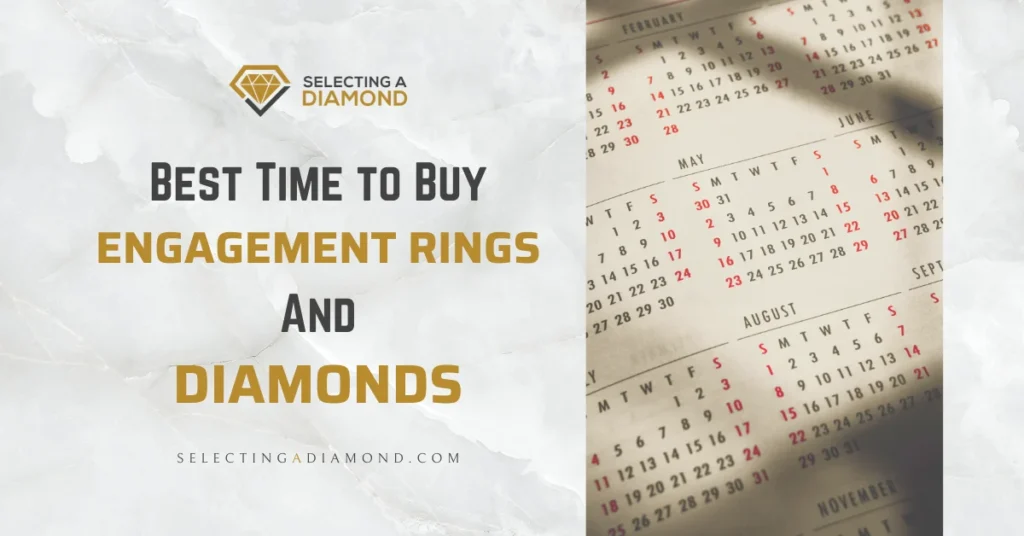
The last week of November. Black Friday through Cyber Monday is when settings, bands and finished jewelry take their deepest discounts of the year, and it falls early enough for a Christmas, New Year or Valentine’s proposal. If you cannot wait that long, September, October and mid-summer are the quiet months when jewelers get flexible.
The pattern is consistent enough to plan around. In twelve years of watching prices for our readers, we’ve found that the November window moves setting prices and leaves loose diamond prices almost exactly where they were in October.
So the ring gets cheaper, the stone does not. That single fact decides how you should shop.
The practical move is to pick your stone on its own merits, then let the calendar decide when you pay for the metal around it. If you want the full pre-purchase checklist first, feel free to read our guide to the things you should know before buying an engagement ring, then come back to the timing.
Why Loose Diamonds Almost Never Go on Sale
Because the margin is already thin. Reputable online retailers price loose stones close to wholesale all year, so there is nothing left to hand back as a discount. Brick and mortar stores can advertise 40% off a diamond because they started 20% to 30% higher. The sale sign is doing arithmetic, not generosity.
Take a real example we recorded while researching this page: an Excellent 1.01 H VS2 diamond was listed at James Allen for $4,640, a stone a local store would have priced at $5,500 to $6,000. James Allen closed in 2026, but the economics have not changed at all.
Want to test it yourself? Note the price of three stones you like, then check the same stones a week into the holiday sales. Feel free to browse Blue Nile’s loose diamond search and keep your own notes.
Remember this: the date on the calendar barely moves the price of the stone. It moves the price of the setting, and on a halo or pavé design that is hundreds of dollars, sometimes more than $1,000 on an expensive mounting.
When Do Engagement Rings Go on Sale?
Five times a year, reliably: Black Friday, Cyber Monday, the Christmas run-up, Valentine’s Day and Mother’s Day. Two quieter windows also work in your favour, the September to October off-peak stretch and the end of a financial quarter. Almost all of these discounts apply to settings, bands and finished jewelry.
Here are the eight windows, ranked by how much they actually save you.
1. Black Friday
It would be nearly criminal to discuss diamond shopping seasons without starting here. Black Friday falls on the Friday after Thanksgiving, and the jewelry industry treats it as seriously as electronics does.
The 2023 numbers give you the shape of a typical year: 25% off settings, jewelry and fancy color diamonds at James Allen, and up to 40% off comparable collections at Blue Nile, with loose diamonds excluded from both.
So watch your chosen setting for two or three weeks beforehand. That is the only way to know whether the sale price is a real one.
2. Cyber Monday
Cyber Monday lands on the first Monday after Thanksgiving, generally between November 25th and December 2nd, and most retailers now run it as a continuation of Black Friday rather than a separate event.
The catch is inventory. The best-selling settings and preset rings often sell through in the first 48 hours, which leaves Cyber Monday with the same percentages and fewer options.
So which one wins? Black Friday, almost every year. Have your budget ready for the Friday, and treat Monday as the backup plan.
3. Christmas and Year-End Sales
Christmas is one of the loudest discount seasons of the year, and nearly every jewelry brand joins in. There is a trap inside it though, because retailers know December shoppers are rushed and stop comparing prices.
That is why we tell readers to shop in November for a December gift. Same sale season, calmer decision, better stock.
4. Valentine’s Day
What do Valentine’s Day and diamonds share? A single universal theme. Because the day carries no religious observance, you often see broader jewelry promotions than at Christmas, as brands push volume before the next holiday season arrives.
Demand also spikes, and when demand spikes prices hold firm or drift upward. Certain shapes move with it: heart-shaped stones get popular every February, and popularity is not your friend as a buyer.
Buy in January for February. If you are still choosing a shape, our guide to the best diamond shape for an engagement ring will save you from paying a seasonal premium.
5. Mother’s Day
Mother’s Day has become a genuine competitive event for jewelers, and competition on a non-traditional holiday tends to produce honest sales rather than inflated ones.
Earrings, pendants and bracelets carry the deepest reductions in this window. Even if you have no Mother’s Day gift to buy, it is a sensible moment to pick up a stone for a birthday or anniversary later in the year.
6. September and October, the Off-Peak Window
Late summer through early fall is wedding season, so bands and finished jewelry move, but engagement ring shopping goes quiet. Suppliers run specials through the off-peak stretch simply to keep the business ticking over.
It also gives you breathing room. Buy in September or October and you can plan the proposal around the holidays without December’s queue behind you.
7. The End of a Financial Quarter
Sellers with quarterly targets get motivated in the final two weeks, and a motivated seller is a negotiable seller. This works far better in a physical store than online, where prices are set by algorithm and not by a manager who needs one more sale.
8. Clearance Sales
Clearance can appear at any point in the year, not only at the end of a season. Discontinued settings, one-off designs and returned pieces are where the real reductions sit, and budget-conscious buyers who stay patient do well here.
Occasionally a loose stone does get marked down in a clearance. Approach that one carefully, and compare it against similar diamonds elsewhere before you believe the number.
Best Month to Buy an Engagement Ring: November, With One Exception
November is the best month. It carries both Black Friday and Cyber Monday, retailers are competing for the same holiday budget, and stock levels are at their annual peak. The exception is July and August, when demand collapses, sales are rare, and a direct conversation about price often gets you further than any advertised percentage.
Those two months work differently. November gives you a discount you can see on the page; midsummer gives you leverage nobody advertises.
If your proposal date is fixed and you cannot reach either window, the honest answer is that it does not matter much. A March purchase from a low-margin online retailer beats a November purchase from a mall jeweler running 60% off inflated tickets, every single time.
Buying a Diamond in Summer: The Quiet Season Advantage
Summer is the slowest retail stretch of the year for most jewelers. Couples marry between June and August, but they bought their rings in spring, so showrooms sit empty and inventory sits still. That makes June through August the easiest months to ask for something off the price and get it.
Inventory carrying costs are what create the opening. A jeweler holding stones through a dead quarter would rather turn one over at a slimmer margin than hold it into autumn.
Tip: even where nothing is advertised, ask. In a slow month, the answer is far more often yes than you would expect, and the worst outcome is that the price stays where it already was.
Proposing in summer and still guessing at her finger size? Our list of clever ways to get her ring size without asking covers twelve of them.
When Is the Best Time to Buy Wedding Bands?
January through March, or the same late-November sale window. Bands are finished jewelry, so unlike loose diamonds they genuinely get discounted, and demand for them drops off sharply after the winter proposal rush ends. Buy them 2 to 3 months before the wedding so there is room for sizing.
Plain metal bands are quick. Diamond eternity and pavé bands are the ones to order early, because matching stones and resizing both take time, and resizing alone runs about a week in most workshops before shipping.
Pairing a band to an existing engagement ring is the part people underestimate. Feel free to look through Blue Nile’s wedding ring range with a photo of the engagement ring beside you, and check the profile of the band against the setting’s gallery.
Best Time to Buy Jewelry: Earrings, Bracelets and Pendants
Finished jewelry is where seasonal sales work hardest, so Black Friday, Cyber Monday and Mother’s Day are your three best moments. Studs, pendants, tennis bracelets and anniversary bands all get percentage discounts that loose diamonds never see, because the retailer controls both the stone cost and the labour.
The saving is real and the maths is simple. A 25% reduction on a finished pair of studs is worth far more than any negotiation you could win on the two stones inside them.
If a gift is on your list for the next six months, feel free to browse their diamond earring collection and their bracelet range during a sale week rather than in the week you need the gift. It is NEVER too early on this category. If a bracelet is the plan, our guide on how to style a tennis bracelet will help you pick the right length first.
How Early Should You Start Shopping?
At least 2 months before the proposal for a preset or in-stock ring, and 3 to 4 months if you want anything customized. That buffer covers choosing the stone without pressure, catching a sale window, resizing, and shipping. Rushed buyers overpay, and they overpay on the setting rather than the diamond.
A bespoke ring takes longer than people expect. You need time to settle on a design, convert it into something a bench jeweler can build, select the stones and then wait for the work itself, and the timeline stretches with the complexity of the piece.
Preset rings are the fast alternative. The centre stone is already set, so the only real delay is resizing, which runs about a week in most stores, plus transit.
Feel free to compare their preset and build-your-own engagement rings side by side before you commit to a custom build. Sometimes the preset version of the design you sketched already exists.
Budget Planning Before the Sale Starts
Set the number before the discounts appear, because a percentage off is only meaningful against a budget you already decided. According to the Natural Diamond Council’s Kristina Buckley Kayel, the average engagement ring sold in 2021 and 2022 came in between $6,500 and $7,000. Plenty of buyers spend far less, and plenty spend far more.
What actually drives the total is the centre stone’s size and quality, then the metal, then the extras: a halo, side stones, or diamonds set into the band.
There is no rule about the figure. Our breakdown of how much to spend on an engagement ring takes apart the two-months-salary myth, and if the budget is tight, how to be frugal about engagement rings has seven ways to cut cost without cutting sparkle.
One priority, though, is not negotiable. Spend on cut first, then carat, because a sale price on a dull stone is not a bargain.
Not All “Sales” Are Genuine
Many are not. Plenty of jewelry stores advertise 60% off while charging the same price they charged in June, and the discount exists only against a list price nobody ever paid. The defence is boring and it works: write down the price weeks in advance, then compare.
Three habits keep you honest here.
Fact: a genuine sale shows a price change on a specific item you were already tracking. A fake one shows a percentage against a number you have never seen.
Second, visit or check at least 2 to 3 sellers on the same specification before deciding. You are not doubting anyone’s authenticity, you are learning the market rate for Ideal cut, H color, VS2 clarity at 1 carat.
Third, if a loose diamond is deeply discounted, ask why. Check the certificate, check the polish and symmetry grades, and read the table and depth percentages before you get excited. Our notes on buying diamonds online cover which sellers hold up to that kind of scrutiny.
Warranties and Insurance: What to Check Before You Pay
Check three things at checkout, whatever season it is: the length of the manufacturer’s warranty, whether the retailer requires periodic inspections to keep it valid, and what your own insurance will cost. A jewelry warranty is voluntary and sits on top of your consumer rights, so read the term rather than assuming it.
Warranty lengths vary by jeweler, from around a year to several. Most cover manufacturing faults, a broken clasp or a stone that drops out of its setting, and some include routine cleaning and inspection.
What a warranty will not cover is loss or theft. That is a separate policy, and our full guide to engagement ring insurance walks through what it costs and how to document the ring properly.
Buying during a sale does not weaken any of this. Discounted price, identical guarantee.
Summary: Final Words on the Best Time to Buy Diamonds
Buy the setting on sale and the diamond on merit. That one sentence is the whole article.
Late November is the strongest week of the year, Valentine’s and Mother’s Day are decent for finished jewelry, and summer is where a quiet negotiation beats every advertised percentage. September and October sit in the middle, calm and reasonably priced.
Do NOT let a sale date pull you into a worse stone. A 25% discount on a Good cut ring leaves you with a ring that looks flat under a restaurant light, and no discount fixes that.
Remember, timing is the cheapest advantage available to a diamond buyer, and it costs you nothing but a note in your calendar.
Frequently Asked Questions on the Best Time to Buy Diamonds
When is the best time to buy an engagement ring?
The last week of November. Black Friday through Cyber Monday brings the deepest discounts of the year on settings and finished rings, and it leaves enough time for resizing before a December or February proposal.
When do engagement rings go on sale?
Five times a year: Black Friday, Cyber Monday, the Christmas run-up, Valentine’s Day and Mother’s Day. Off-peak specials also appear in September and October, and clearance can happen at any time.
What is the best month to buy an engagement ring?
November, for the discounts and the stock. July and August come second, because demand is at its lowest and sellers are far more open to negotiation.
Do loose diamond prices drop during sales?
Rarely. Online retailers already price loose stones close to wholesale, so promotions are applied to settings, bands and finished jewelry instead. Occasional clearance reductions on loose stones are worth checking against similar diamonds before you buy.
When is the best time of year to buy wedding rings?
January through March, or during the late-November sale window. Demand for bands falls after the winter proposal season, and bands are finished jewelry, so they do get genuinely discounted.
How far in advance should you buy an engagement ring?
At least 2 months for a preset or in-stock ring, and 3 to 4 months for a custom design. Resizing alone takes about a week in most workshops, before shipping.
Is Black Friday or Cyber Monday better for engagement rings?
Black Friday, in most years. The percentages are usually the same, but the most popular settings and preset rings sell out first, which leaves Cyber Monday shoppers with fewer options.
Still not sure where to buy your diamond?
Read our full Blue Nile diamonds and jewelry review before you commit to a sale week, so you know what the pricing looks like outside of one.