We may earn a commission when you purchase through our affiliate links, at no extra cost to you. This helps support our work and allows us to continue providing unbiased, expert diamond advice.
Note: Most prices, product details, or comparisons mentioned in this article are based on information available from our trusted partner we frequently reference: Blue Nile. We may earn a commission when you purchase through our affiliate links, at no extra cost to you. This helps support our work and allows us to continue providing unbiased, expert diamond advice.
Browsing for engagement rings online hands you a dazzling array of choices. But those choices can blow straight past your budget, or the setting you fell for refuses to sit well with the only diamond you can actually afford.
Plenty of buyers admit there were things they wish they knew before they started. That is exactly why we built this guide.
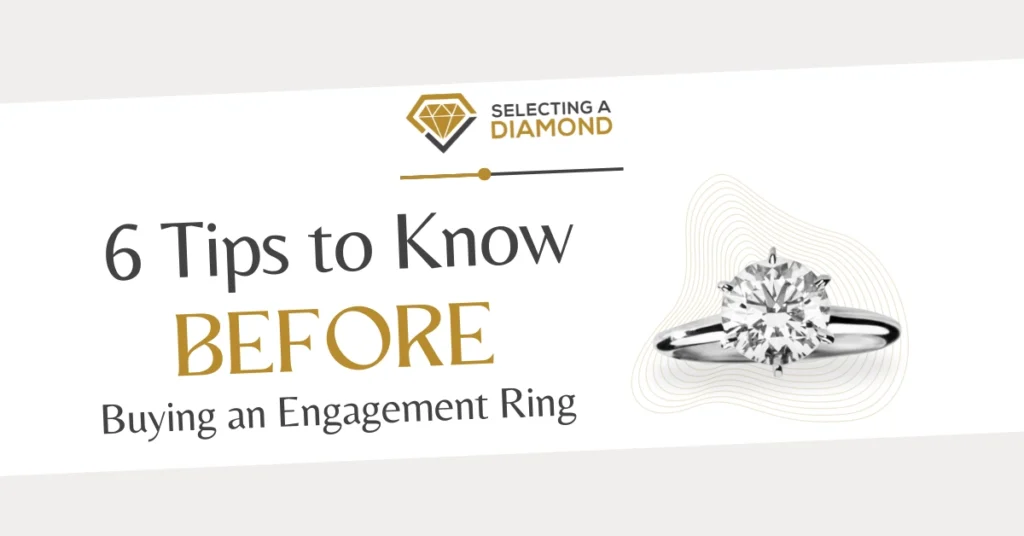
Buying a ring is not regular shopping. Not to pile on the pressure, but you want to be informed before you spend this kind of money, and the six steps below are what we use ourselves.
Summary in a few lines:
- Set the budget for the finished ring first, setting and diamond together, before you look at a single stone.
- There are over 10 diamond shapes, roughly half a dozen metals, and dozens of setting styles, which is where the “hundreds of options” feeling comes from.
- Cut is the only grade you can see from across a room; a one-grade drop in color or clarity is usually invisible.
- Her ring size can be measured in secret, and a soap imprint of a ring she already owns is the most reliable trick of the three.
- Buy the report, not the patter: a GIA-graded stone shown in 360-degree video lets you inspect the exact diamond before you commit.
Table of Contents / Toggle
Why Does Buying an Engagement Ring Feel So Complicated?
Because you are choosing five things at once. Over 10 diamond shapes, dozens of setting styles, about half a dozen metals, four grading scales, and a ring size you may have to guess. Multiplied together, that is hundreds of combinations, which is why the whole thing feels heavier than it is.
Add her personal style, her existing jewelry, and a budget that has a ceiling, and it is easy to stall for weeks.
The silver lining? Decisions made in the right order collapse the list fast. Each answer removes most of the options behind it.
Many couples now shop together, trying on shapes and settings in a store or scrolling through them at the kitchen table. Others still want the surprise, and there is nothing wrong with that either.
Either way, the sequence is the same. Let’s break it down into six steps.
1. Set Your Budget for the Whole Ring (Setting and Diamond)
Decide what you will spend on the finished ring before you shop, and count the setting inside that number. You do not need an exact figure. A range is enough, something like $1k–$2k, $8k–$10k, or $15k–$20k. Carat weight, shape, metal, and clarity all get decided by that range, so choosing it first saves you from loving a stone you cannot buy.
The mistake we see most often is budgeting for the diamond alone. The setting is a real line item, not a rounding error, and an intricate pavé band costs meaningfully more than a plain solitaire.
Tip: if you want a sanity check on the figure itself, read our breakdown of how much to spend on an engagement ring, including why the two-months-salary rule is marketing rather than maths.
Timing moves the number too. Prices and promotions shift through the year, which is why we wrote about the best time to buy diamonds and engagement rings.
2. Pick the Diamond Shape and the Ring Setting
Choose the shape that suits her hand and her taste, then choose the setting that holds it. A round brilliant flatters a small, delicate hand. An elongated shape such as oval, marquise, or emerald stretches the finger and reads larger per carat because more of its weight sits on the surface. Shape first, setting second.
The shape that grabs you on a screen is not automatically the shape that suits her finger. A marquise can swallow a short finger, while the same carat weight in a round or oval sits comfortably.
If visible size matters more than the number on the report, favour shapes with a wide face rather than deep bellies. Emerald and oval both do this well.
For a shape-by-shape walk-through with real hand shots, see our guide on how to choose diamond shape, and if she leans elongated, our roundup of popular oval cut engagement rings covers what to check on that shape specifically.
Settings are the easier half of this step, because a setting can be changed later and a diamond cannot. Solitaire keeps all the attention on the stone, a halo borrows apparent size from melee stones around it, and a three-stone design reads more traditional.
Once you know which of those three families she belongs to, feel free to browse the full run of engagement ring settings on Blue Nile and see how the same stone looks in each. Comparing settings with the diamond held constant is the fastest way to learn your own taste.
3. Match Her Other Jewelry and Metal Color
Look in her jewelry box before you look at rings. If everything she owns is silver-toned, buy white gold or platinum. If her pieces are warm, buy yellow gold and stop debating. Round diamonds read traditional, emerald cuts read elegant, and princess, pear, and marquise read modern, so pick the one her existing jewelry already agrees with.
This is the cheapest step in the whole process and the one people skip. A ring that clashes with the earrings she wears daily gets noticed every single day.
Listen for hints as well. Does she comment on rings she sees in magazines or on a friend’s hand? If she says nothing, her close friends or family usually know, as long as they can keep a secret.
Metal also decides how her wedding band will sit against the engagement ring later, so it is worth thinking one ring ahead. When you are ready for that part, feel free to look at matching wedding rings in the same metal.
For the metal decision on its own, read our comparison of the best ring metal to choose for an engagement ring. And before anyone tells you the two rings must match perfectly, see the engagement ring and wedding band rules that are safe to ignore.
4. How Do You Get Her Ring Size Without Asking?
You get it from a ring she already owns. Borrow one she has not worn recently and have it measured, press it into a bar of soap and take the imprint to a jeweler, or ask a friend who can keep a secret. Yes, most rings can be resized afterwards. A ring that fits at the proposal is still worth the small effort.
Borrow one of her rings: if you live together, take a ring she wears on the correct finger to a jeweler and have it measured in minutes.
Make an imprint: the best option of the three. Press one of her rings into soap, keep the imprint intact, and let the jeweler measure it. Nothing leaves the house for long.
Ask her people: a sister or a best friend often knows the number already, and a good one will not spoil the surprise.
Want more angles on this, including the tricks that work when you do not live together? We collected 12 clever tricks to get her ring size without asking.
If the size does miss, it is rarely a crisis, though it is not a same-afternoon job either. Our guide on whether an engagement ring can be resized explains which settings resize easily and which ones fight back.
5. Judge the Diamond: The 4Cs
Cut, color, clarity, and carat weight decide what the stone looks like and what it costs. They are not equal in effect. Cut governs sparkle and is the one difference the naked eye catches, while carat only measures weight rather than the size she sees on her hand. Buy cut first, then economise on color and clarity.
That ranking is the single most useful thing on this page. We laid out the reasoning in full in our guide to the 4Cs and their order of importance.
5.1 Cut: The One Grade You Can See
Cut refers to the proportions of the stone and how well its facets return light to your eye. Table and depth percentages, symmetry, and polish all feed into it.
In twelve years of pulling stones up side by side for readers, we’ve found that a drop from Ideal to Good is visible across a dinner table, while a drop from VS1 to SI1 clarity or from E to H color usually is not. That is the whole hierarchy in one sentence.
So a dull, lifeless diamond is almost always a cutting problem rather than a clarity problem. We consider this the one grade worth paying full price for, and (how can we say this) the one place where saving money shows.
To test it yourself, hold carat, color, and clarity steady and change only the cut grade in Blue Nile’s loose diamond search, then watch the video on each stone. The difference is not subtle.
Tip: some retailers offer a premium tier above Excellent, and Blue Nile’s is called Astor. It is worth mentioning that this is not a grade GIA defines, which is why we tested it separately in our Astor vs Ideal cut review.
For the full technical picture, including proportions and light return, read our diamond cut scale chart.
5.2 Color
White diamond color runs from D, meaning colorless, down through J and beyond as warmth creeps in. D commands the highest price on any given search.
Retailers will tell you that the least color possible is preferred. The same pages usually admit, a few paragraphs lower, that most people find it very difficult or impossible to tell one grade from the next, while the price gap between those grades is significant.
Both statements are true. The second one is the one that saves you money, particularly in a yellow gold setting, where a warmer stone reads perfectly white against the metal.
Our diamond color chart on the official GIA scale shows the grades side by side, and if you are stuck between two of them, our G vs H diamond color comparison settles it with prices. Fancy shades follow a completely separate scale, covered in our fancy color diamonds chart.
5.3 Clarity
Clarity describes how clean the stone is internally. Grades run from FL for Flawless down to I3 for heavily Included, judged under 10x magnification.
Marks inside the stone are inclusions; marks that reach the surface are blemishes. Not all of them behave the same way, and our guide to diamond inclusion types separates the harmless ones from the ones that threaten durability.
What matters is whether the diamond is eye clean at arm’s length, not what a loupe finds. Our diamond clarity chart from FL to I3 has large images of real stones so you can judge for yourself, and which clarity grade is best value for money gives the practical answer.
5.4 Carat Weight
Fact: the modern carat was standardised in 1907 at the Fourth General Conference on Weights and Measures, where it was fixed at 200 milligrams. That definition has held ever since.
Carat is weight, not size. Two stones of identical weight can present very different faces to the eye, depending on how the weight is distributed between the crown and the pavilion.
So do not chase the bigger number before you have secured the cut grade. A well-cut lighter stone beats a heavy stone hiding its weight in a deep belly. To see how weights translate to millimetres on a real hand, see how big a 1 carat diamond actually is.
What Does an Engagement Ring Cut Chart Show?
A cut chart ranks how well a diamond’s proportions return light, from Poor at the bottom to Excellent, which many retailers and the AGS scale call Ideal, at the top. GIA uses five grades for round brilliants. The chart measures light performance only, so it says nothing about the diamond’s shape.
That distinction trips up a lot of buyers. If you have been using “cut” to mean the outline of the stone, our guide to the different types of diamond cuts and shapes covers that side of the vocabulary.
Here is what each rung on the grade chart actually means for a ring you intend to look at every day.
1. Poor
Light enters and leaks straight out of the bottom or the sides. The stone looks glassy and dead, even in good light. Reputable online sellers do NOT stock these, and you should not go hunting for one.
2. Fair
Some light comes back, but the stone reads flat next to anything better. This is the grade where a bargain price stops being a bargain. Just never get a Fair cut diamond for an engagement ring.
3. Good
You would think good is actually good. In diamonds, a Good cut is really rather poor, and this grade (ironically named good) gives up a visible amount of brilliance to save a modest amount of money.
4. Very Good
Genuinely attractive, and the sensible floor if the budget is tight. A Very Good stone sitting next to an Excellent one loses the comparison, but on her hand, alone, it performs well.
5. Excellent | Ideal
Maximum light return, and the grade we recommend without hesitation. If something has to give, let it be a tenth of a carat or a color grade. The cut, always.
Remember this: the cut grade on the report describes the stone in front of you, not the shape family it belongs to. Two Excellent stones of the same shape can still look different, because every diamond is its own object.
6. Where Should You Buy an Engagement Ring?
Buy where you can inspect the exact stone before you pay for it. Online sellers show the individual diamond in 360-degree video with its grading report attached, carry a far deeper selection than any single display case, and price lower with nobody leaning over your shoulder. A good local jeweler still wins on custom work and on-the-spot sizing.
The old worry was trust. That worry made sense fifteen years ago and makes much less sense now, because the video and the report together tell you more than a five-minute look through a counter loupe ever did.
James Allen built its reputation on exactly that, and its imaging was unmatched at the time. The brand shut down in August 2026, and its collections now live inside Blue Nile.
Selection is the other advantage, and it is not close. Filter by shape, carat range, cut grade, and certifying lab, then read the report before you spend anything, and you have done more due diligence than most in-store buyers manage.
When you are at that stage, feel free to work through Blue Nile’s loose diamond search with your shortlist of specs in hand.
For the longer version of this argument, including how to vet a seller, read our guide to buying diamonds online and our full engagement rings buying guide.
What Should You Know Before Buying Your First Engagement Ring?
Four things, according to the buyers who write to us. The setting is a separate cost from the stone. The grading report matters more than the sales patter. Resizing takes days rather than minutes. And the ring is uninsured from the moment it leaves the store. None of the four is expensive to handle early.
Start with the report. An unbranded certificate from an unfamiliar lab can inflate color and clarity by grades, which is why we compare labs in our diamond certification guide.
Insurance is the one people postpone and regret. A separate rider or policy costs a small fraction of the ring per year, and our walk-through of engagement ring insurance explains what an appraisal needs to say.
Return terms vary by seller and they change, so read the current policy on the product page rather than trusting a number you saw in an article. We are not going to quote one here.
And the presentation matters more than you expect, because that is the part she will describe to people for years. If you want ideas, see our guide on how to choose an engagement ring with boxes.
Summary: Final Words on Choosing an Engagement Ring
The process only feels enormous because everything arrives at once. Taken in order, it is six decisions, and each one narrows the next.
Set the total budget, pick the shape that suits her hand, choose a setting and metal that agree with the jewelry she already wears, get the size quietly, then buy the best cut your range allows.
Where you buy comes last, and it comes down to one test: can you see this exact diamond, in video, with its report, before you pay? If yes, you are in a good position.
Cut over carat, every time. That is the one rule we would keep if we had to throw out the other five.
Frequently Asked Questions on Choosing an Engagement Ring
How do you choose an engagement ring?
Set a total budget for stone and setting, choose a diamond shape that suits her hand, match the metal to the jewelry she already wears, confirm her ring size discreetly, prioritise cut over carat within the 4Cs, and buy from a seller that shows you that exact diamond with its grading report.
What should you look for when buying a diamond ring?
Look at the cut grade first, because it decides sparkle and it is the only grade the naked eye reliably catches. Then check that the stone is eye clean, that the color suits the metal, and that the report comes from a lab you trust.
What is an engagement ring cut chart?
It is the scale that ranks light performance from Poor to Excellent, called Ideal on the AGS scale and by many retailers. GIA uses five grades for round brilliants. It grades proportions and light return, not the outline of the stone.
How do you choose a proposal ring without her knowing?
Work from evidence she has already given you. Borrow a ring for sizing or press it into soap, note whether her jewelry is silver-toned or warm, and ask one trustworthy friend about shape preferences. Then buy a classic setting, which is the safest bet when you are guessing.
What do people wish they knew before buying an engagement ring?
That the setting is a separate cost, that a one-grade drop in color or clarity is invisible while a drop in cut is not, that resizing takes days, and that the ring needs insuring immediately rather than eventually.
Is a bigger carat better than a better cut?
No. Carat measures weight, not the face size she sees, and a poorly cut heavy stone can look smaller and duller than a lighter Excellent cut stone at the same price. Secure the cut grade first, then spend what is left on weight.
Does the engagement ring have to match the wedding band?
It does not. Matching metals looks tidy and the two rings should sit comfortably together, but identical styling is a convention rather than a rule, and mixed-metal stacks are common now.
Still not sure where to buy your diamond?
We always recommend shopping diamonds online, and we put together a full guide to shop diamonds like a pro.
Among online retailers, Blue Nile is where we do most of our own looking: the widest range of loose diamonds across every size, imaging on the bulk of the inventory, and customer support that answers questions properly. Our detailed Blue Nile diamonds and jewelry review covers the good and the less good.