We may earn a commission when you purchase through our affiliate links, at no extra cost to you. This helps support our work and allows us to continue providing unbiased, expert diamond advice.
Note: Most prices, product details, or comparisons mentioned in this article are based on information available from our trusted partner we frequently reference: Blue Nile. We may earn a commission when you purchase through our affiliate links, at no extra cost to you. This helps support our work and allows us to continue providing unbiased, expert diamond advice.
Summary in a few lines:
- A 1 carat round diamond measures roughly 6.4mm across the top, and it weighs exactly 200 milligrams, which is 0.2 of a gram.
- Carat is weight, not width. A 2 carat round is about 8.2mm wide, so it is around 28% wider than a 1 carat, and it is NOT double the size.
- Shape changes the footprint at identical weight: a 1 carat oval reads about 7.7mm long, while a 1 carat round reads about 6.4mm.
- Cut outranks carat every time. A 1 carat excellent cut beats a 2 carat good cut, and it isn’t close.
- Buying at 0.90 to 0.95 carat instead of a full 1.00 saves real money for a size difference nobody can see.
Most people start their search by typing a carat weight into a filter and hoping for the best. That is the wrong order. Let’s start with the basics, then work up to the sizes on the hand.
How Big is a 1 Carat Diamond?
A 1 carat round diamond measures roughly 6.4mm across the top and weighs 200 milligrams, or 0.2 of a gram. On an average finger it reads as clearly visible without taking over the hand, which is exactly why 1 carat became the benchmark that almost every shopper starts from.
You might think 0.2 of a gram sounds tiny. It isn’t, not on a hand.
The number that actually controls how big the stone looks is the face-up diameter, not the weight, because you view a diamond from the top and a large share of the weight is hidden below in the depth of the stone.
Fact: two diamonds can both weigh 1.00 carat and still differ by two or three tenths of a millimetre in diameter, depending on how the cutter distributed the weight.
What Are Diamonds Measured In?
Diamonds are measured in two separate units. Weight is measured in carats, where 1 carat equals 200 milligrams (0.2 grams), and each carat splits into 100 points, so a 0.75 carat stone is a 75 pointer. Physical size is measured in millimetres: length, width and depth, printed on the grading report.
Both numbers appear on every GIA report, and they answer different questions. Carat tells you what you are paying for. Millimetres tell you what she will see.
The report also converts those millimetres into ratios, which is where the best diamond table and depth percentages come from, and those ratios decide whether the weight sits usefully in the crown or gets buried in a bloated pavilion.
Carat vs. Size: They Aren’t The Same
Carat is weight; size is dimensions in millimetres. The two are used interchangeably in shops and they should not be. Two stones of identical carat weight can look noticeably different in face-up size, because cut proportions and shape decide how much of that weight you actually see from above.
A common misconception is that a higher carat weight automatically means a visibly larger diamond. It doesn’t always.
A deep-cut stone hides weight in the pavilion and looks small for its price. A shallow one spreads wide and looks big, then leaks light out of the bottom and goes lifeless in the centre.
Elongated shapes change the maths again. Oval, pear and marquise cover more finger than a round or a princess of the same weight, simply because their outline is longer.
If shapes are new territory, our guide to the different types of diamond cuts and shapes lays out how each one behaves.
Diamond Measurements and Size Chart per Carat
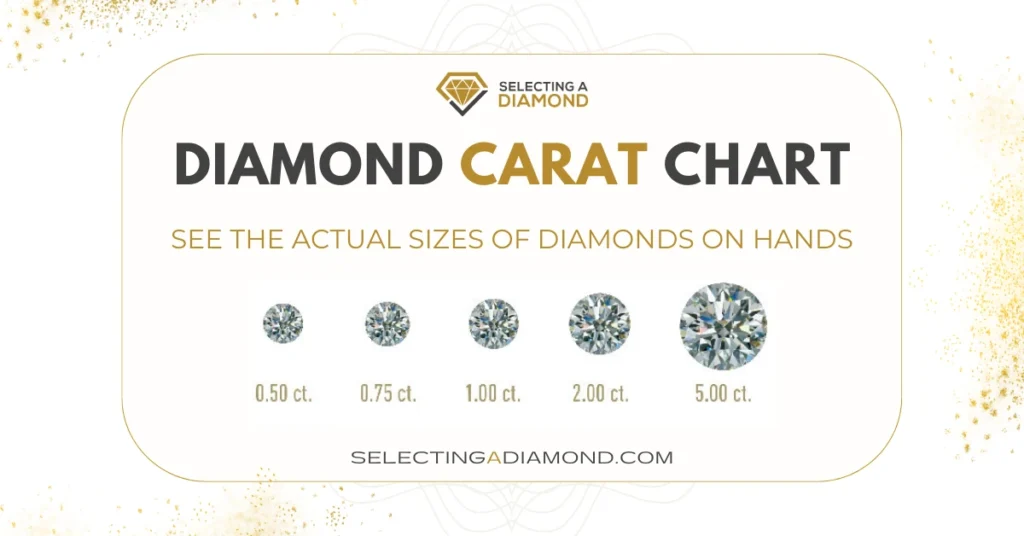
For round brilliants, the standard face-up diameters run roughly like this: 0.50 carat about 5.2mm, 0.75 carat about 5.8mm, 1.00 carat about 6.4mm, 1.50 carat about 7.4mm, 2.00 carat about 8.2mm, and 3.00 carat about 9.3mm. Well-cut stones sit within a tenth or two of these figures.
Here is what each of those carat sizes actually does on an average hand.
1. 0.50 Carat: about 5.2mm
A half carat round sits comfortably inside a slim band and reads as neat rather than statement. It is the size most people buy when the budget goes into cut and setting instead of weight. On a smaller finger it looks bigger than the millimetres suggest.
2. 0.75 Carat: about 5.8mm
Three quarters of a carat is the quiet value spot. You gain about 0.6mm of diameter over a half carat, which is visible side by side, and you stay well under the price step that the 1.00 mark triggers.
3. 1.00 Carat: about 6.4mm
The benchmark. A 1 carat round covers a genuine slice of an average finger and is instantly read as a proper solitaire. It is also the single most demanded weight on the market, which is precisely why it is priced the way it is.
4. 1.50 Carat: about 7.4mm
One and a half carats stands out effortlessly without looking borrowed. The extra millimetre over a 1 carat reads as roughly a third more surface area from above. On a petite hand this is often the practical ceiling.
5. 2.00 Carat: about 8.2mm
A 2 carat round is unmistakably large in person, and it needs a setting with enough metal underneath to carry it. Be careful here, since not all hands are equal, and a stone that looks balanced on a size 7 finger can swamp a size 4.
6. 3.00 Carat: about 9.3mm
Three carats is a statement, full stop. At 9.3mm across it spans most of the width of an average finger and will catch light from across a room. Make sure it isn’t wearing her instead of the other way round.
1 Carat vs 1.5 Carat: The Real Size Difference
A 1.50 carat round is about 7.4mm wide against 6.4mm for a 1.00 carat. That is roughly 16% more diameter and about a third more surface area seen from above, which is visible when the two sit side by side and much less obvious when they don’t.
Half a carat more weight does not buy you half again as much diamond on the finger. It buys you one millimetre.
The price gap, on the other hand, is nowhere near proportional either, because price per carat climbs as weight climbs. Our pillar guide to diamond price per 1 gram and 1 carat explains exactly how that curve behaves.
Want to see it for yourself? Filter for the same colour, clarity and cut at both weights in Blue Nile’s loose diamond search and compare the millimetre measurements listed on each report.
1.5 vs 2 Carat: Round and Oval Compared
In round, 1.50 carat runs about 7.4mm across and 2.00 carat about 8.2mm, so you gain roughly 11% in width and about 23% in face-up area. In oval, a 1.50 carat measures around 8.8 x 6.5mm while a 2.00 carat measures around 9.7 x 7.2mm.
The oval wins on presence at both weights. Its long axis covers more finger than any round of equal weight, which is the whole reason elongated shapes feel bigger than the scale says they are.
Where ovals get tricky is the dark band across the centre, so if you are choosing between these two weights in oval, read up on the bow tie effect in oval diamonds before you commit.
For setting ideas at these weights, our roundup of popular oval cut engagement rings shows how the same stone changes character depending on the band it sits in.
Tip: if the choice is a 2.00 carat with mediocre proportions or a 1.50 carat cut properly, take the 1.50 and don’t look back.
Diamond Carat is NOT Gold Karat, Not Even Close
Carat measures diamond weight; karat measures gold purity. They are different units doing unrelated jobs, and the confusion exists because the UK spells gold purity “carat” too. Diamond carat says nothing about purity, and gold karat says nothing about weight or size.
Gold karat sizes work out of 24 parts. 24K is 24 out of 24, meaning 100% gold; 18K is 18/24, or 75%; 14K is 14/24, or about 58.3%; and 10K is 10/24, or about 41.7%.
The lower the karat, the more alloy metal is mixed in, which makes the piece harder and cheaper but paler in colour. If you are weighing up band metal, our comparison of 10k vs 14k gold covers the trade-off properly.
So: karat sizes describe the metal, carat sizes describe the stone. We have had readers ask about this often enough that it deserved its own section.
How Does Setting Style Affect a Diamond’s Perceived Size?
The setting can add or subtract the equivalent of a quarter carat in perceived size. A halo of small stones around the centre reads as one larger outline; thin prongs leave almost the whole stone exposed; a bezel wraps metal around the girdle and visibly shrinks the diamond it holds.
The halo is the most effective trick there is. A ring of melee around the centre stone expands the visual outline while adding sparkle at a fraction of the cost of extra carat weight.
A four prong setting shows more of the girdle than a six prong, so the fewer and finer the prongs, the more diamond you see. That is a genuine difference, not a marketing one.
Bezels go the other way. They protect the stone beautifully and they make it look smaller, and both of those things are true at once.
You can compare all three side by side in the halo, prong and bezel engagement ring settings on Blue Nile, using the same centre stone weight in each preview.
1 Carat Actual Size on Hand for Different Shapes
At exactly 1.00 carat, the face-up dimensions change with shape: round about 6.4mm, princess about 5.5mm square, oval about 7.7 x 5.7mm, heart about 6.5 x 6.5mm, emerald about 7.0 x 5.0mm, and marquise about 10.0 x 5.0mm. Same weight, wildly different footprints.
The marquise covers nearly 60% more length than the round at identical weight. The princess looks the smallest of the group from directly above, because a lot of its weight sits in the corners and the depth.
So why does round still dominate demand? Because beauty is mostly about how much light comes back to your eye, and the round brilliant returns more of it than any other shape.
That is also why carat sits last in the 4Cs in order of importance. Size is the easiest thing to buy and the least interesting thing to look at.
Which Matters More, Cut or Carat?
Cut matters more, and it isn’t a close call. Cut governs how much light returns to the eye, while carat only governs weight, so a 1 carat excellent cut will out-sparkle a 2 carat good cut at any distance a human being actually stands. Buy the cut grade first, then spend what is left on size.
Take three round diamonds of identical carat weight, one shallow, one deep, one cut to ideal proportions. The shallow one has the widest crown of the three.
It is also the one you should walk away from. A shallow stone spreads its weight sideways and leaks light straight out of the bottom, so it buys you millimetres and sells you brilliance.
In twelve years of pulling stones for readers, we’ve found that carat is the number people ask about first and the one they regret optimising for later. Nobody has ever come back to tell us their diamond was too small. Plenty have told us it looked dull.
For the full breakdown of how each grade behaves, read our guide to how diamond cut affects brilliance.
Buying Tip: Our Recommendation Based on Diamond Size Chart
Put simply, allocate the majority of the budget to cut, then clarity, then colour, and let carat take whatever is left. Then shop just under the round-number weights, because 0.90 to 0.95 carat and 1.40 to 1.45 carat are priced meaningfully lower than 1.00 and 1.50 for a diameter difference of about a tenth of a millimetre.
That tenth of a millimetre is invisible. Not “hard to see”, invisible, even with the two stones next to each other on a tray.
Vendors know demand spikes at the whole and half carat marks, and they price accordingly. Buying at 0.93 instead of 1.00 is the single cleanest saving available in the whole 4Cs.
On clarity, start your search at SI1 grade, which is eye-clean in the large majority of stones, and only move up if the specific diamond in front of you needs it.
If you prefer to shop online, and we think you should, our guide to buying diamonds online covers the process end to end. When you have the stone sorted, the last step is getting her ring size without asking.
Summary: Final Words on Diamond Carat Size
Carat is a weight unit, 200 milligrams of it, and it is not a size unit no matter how the trade talks. Size lives in the millimetre measurements on the report.
A 1 carat round is about 6.4mm, a 1.5 carat about 7.4mm, and a 2 carat about 8.2mm, so doubling the weight adds under two millimetres of width. Shape moves that footprint more than most people expect, and the setting moves it again.
Get the cut right first. Everything you like about a diamond, the flashes, the fire, the way it reads across a table, comes from proportions, and no amount of extra weight compensates for a stone that has been cut to save weight instead of to return light.
Remember this: the diamond people notice is rarely the heaviest one in the room.
Frequently Asked Questions on Diamond Carat Size
How big is a 1 carat diamond?
A 1 carat round brilliant measures roughly 6.4mm across the top and weighs 200 milligrams. On an average finger it is clearly visible as a proper solitaire without dominating the hand.
Is carat the size of a diamond?
No. Carat is a weight unit equal to 0.2 grams. Size is the length, width and depth in millimetres, and two stones of the same carat weight can look different in size depending on cut and shape.
What are diamonds measured in?
Two units. Weight in carats, split into 100 points per carat, and physical dimensions in millimetres. Both appear on a GIA report.
What is the difference between 1 carat and 1.5 carat?
About one millimetre of diameter in round: roughly 6.4mm against 7.4mm. That works out to around a third more surface area viewed from above.
Is a 2 carat diamond twice the size of a 1 carat?
No. A 2 carat round is about 8.2mm wide against 6.4mm, so it is roughly 28% wider, not 100% bigger. The extra weight is largely hidden in the depth of the stone.
Which is better for an oval ring, 1.5 or 2 carat?
A 1.5 carat oval runs around 8.8 x 6.5mm and a 2 carat around 9.7 x 7.2mm. If the choice costs you cut quality, take the 1.5 carat with better proportions.
Is diamond carat the same as gold karat?
No. Karat measures gold purity out of 24 parts, so 18K is 75% gold and 14K is about 58.3%. Diamond carat measures weight only and says nothing about purity.
Still not sure where to buy your diamond?
We always recommend shopping diamonds online, and we put together a full guide to shopping diamonds like a pro.
Blue Nile: the widest collection of loose diamonds across every size range, solid imaging on the large majority of the inventory, and customer support that answers properly. Feel free to browse their loose diamond inventory and compare the millimetre measurements yourself.