We may earn a commission when you purchase through our affiliate links, at no extra cost to you. This helps support our work and allows us to continue providing unbiased, expert diamond advice.
Note: Most prices, product details, or comparisons mentioned in this article are based on information available from our trusted partner we frequently reference: Blue Nile. We may earn a commission when you purchase through our affiliate links, at no extra cost to you. This helps support our work and allows us to continue providing unbiased, expert diamond advice.
Lab-grown diamond pricing in a few lines:
- A 1-carat lab-grown diamond has been selling in the $1,000 to $1,500 range, while a comparable natural stone sits at $4,000 to $5,000 or more.
- Growing the rough is only one line on the invoice; cutting, polishing, certification and retail margin make up the rest.
- The 4Cs price a lab diamond exactly the way they price a natural one, but carat premiums climb far more gently.
- Resale is harsh: roughly 10-20% back on a lab stone, against 50-60% on a mined one.
- Prices have been sliding for years, and we expect them to settle rather than collapse.
Table of Contents Toggle
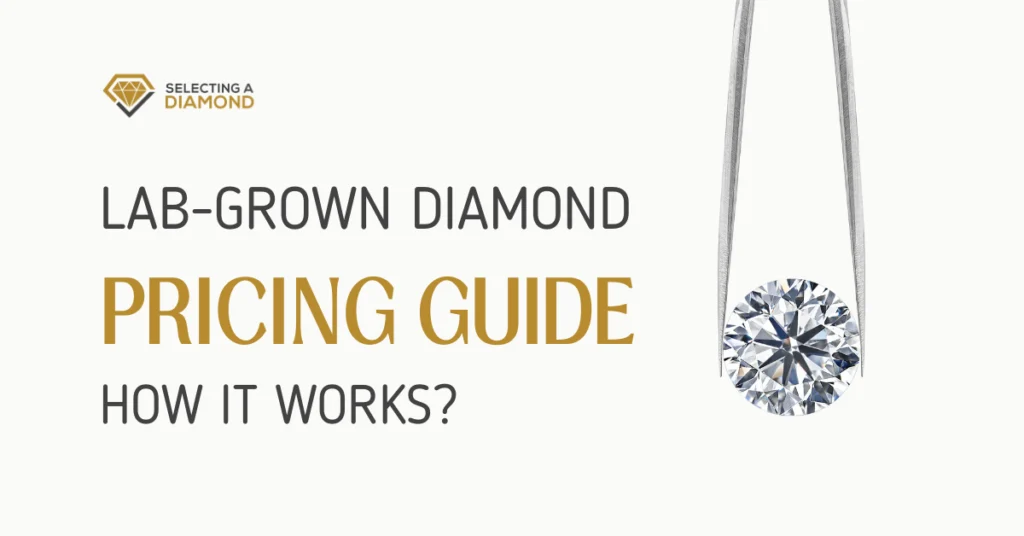
Lab-grown diamond pricing looks confusing from the outside, and it moves faster than natural diamond pricing does. Here is how the number on the tag is actually built, piece by piece.
Let’s start with the figure everyone came for.
What Do Lab-Grown Diamonds Cost?
A 1-carat lab-grown diamond in a sensible quality range has been selling for roughly $1,000 to $1,500, while a natural stone at similar grades runs $4,000 to $5,000 or more. Half-carat stones cost a fraction of that. Prices keep drifting downward as growers add capacity, so treat any figure you read, including ours, as a snapshot.
The spread inside that range is wide, and cut grade drives most of it. Two 1-carat lab diamonds with identical color and clarity on the report can sit hundreds of dollars apart.
That difference? It’s the cut doing the work.
Because lab prices move week to week, a chart printed today is stale by next quarter. If you want the live number rather than an average, feel free to sort Blue Nile’s loose diamond search by carat weight and read the prices on the day you shop.
How Much Does a Lab-Grown Diamond Cost to Make?
Nobody publishes a reliable cost per carat, and growers guard the figure closely. What we can list is what goes into it: reactor time measured in weeks, a heavy electricity bill, diamond seed plates, skilled operators, then cutting, polishing, grading and shipping. Growing the rough is one line on that invoice, and it is no longer the biggest one.
Two methods do the growing. High Pressure High Temperature, the HPHT method, squeezes carbon inside a press that mimics conditions deep under the earth’s crust.
Chemical Vapor Deposition, the CVD method, builds the crystal layer by layer inside a vacuum chamber fed with carbon-rich gas. Both need serious equipment and both drink electricity, which is exactly why the first commercial lab stones carried high prices.
Fact: the growth method has no effect on how the finished stone looks. HPHT or CVD, once the rough is cut and polished, you will not tell them apart at the counter, and neither will your jeweler without lab equipment.
Production costs fell for a boring reason: more presses, more chambers, larger reactors, better yields per cycle. When a factory can raise output the moment demand rises, scarcity pricing stops working.
Which brings us to the three forces behind the retail tag.
3 Forces That Set Lab-Created Diamond Prices
Three things set the price you pay: the production technology behind the rough, the 4Cs of the finished stone, and plain supply and demand. Natural diamond prices are steered by a small group of miners who control how much rough reaches the market. Lab diamond prices are steered by factory capacity, and factories can always build more capacity.
1. Production Technology
HPHT presses and CVD chambers represent real investment in equipment, energy and skilled labor. As the cost per carat of running them drops, the saving reaches the shelf fairly quickly. That is the single clearest reason lab prices have fallen while mined prices have not.
2. Quality Factors
Color, clarity, cut and carat price a lab diamond exactly the way they price a natural one. Better grades cost more, and larger carat weights cost more again. The grading scale does not care where the carbon came from.
3. Market Dynamics
Demand rises, and growers simply run more cycles. That is the structural difference from mined stones, where a new deposit takes years to reach a shop window. Supply that responds in weeks keeps a permanent lid on price.
The 4Cs and Other Traits That Move Lab Diamond Prices
Cut moves the sparkle the most, carat moves the price the fastest, color and clarity move it quietly, and shape and certification adjust it at the margin. Grade a lab stone the way you would grade a natural one, then decide deliberately where you are willing to spend and where you are not.
1. Color
Color runs from colorless (D grade) down to light yellow or brown at Z, and higher grades cost more. For a balance of value and appearance, G to H is the sweet spot.
Those grades look colorless to the naked eye in most settings, at a real discount to D-F. If you are torn between the two, our comparison of G vs. H diamond color lays the difference out side by side.
2. Clarity
Clarity grades run from Flawless, with nothing visible under 10x magnification, down to Included, where inclusions are visible without a loupe. VVS grades carry the biggest premium.
VS2 and SI1 are the value grades. Inclusions at that level are minor and usually invisible to the naked eye, so the stone still reads crystal clear on a hand.
3. Cut
Cut covers proportions, symmetry and polish, and it decides how much light comes back to your eye. Grades run Excellent down to Poor, and the price follows.
Opting for Excellent buys brilliance and fire that you can see across a room. It is the one grade we tell readers never to economise on.
4. Carat
Price does not scale in a straight line with weight: a 2-carat stone is not double the price of a 1-carat stone, it is considerably more. In mined diamonds those jumps get wild at the top of the scale, while in lab diamonds they stay comparatively tame.
Our diamond carat size chart shows how little visual size you gain between neighbouring weights. A slightly smaller stone with better cut, color and clarity often wins on the hand.
5. Shape
Round brilliants are usually the most expensive shape, because they are the most requested and because more rough is sacrificed in cutting. Fancy shapes such as oval, pear or marquise typically land a little lower for the same weight.
If you are still choosing, our guide to the different types of diamond cuts and shapes covers how each one wears.
6. Certification
A report from GIA or IGI confirms the grades independently, and it costs the retailer money, which shows up in the price. Buy the report anyway.
An uncertified lab diamond is a stranger’s opinion with a price tag attached. For anything above pocket money, that is not a saving.
Lab-Grown vs. Natural Diamonds: The Price Gap Explained
A lab-grown diamond costs a fraction of a comparable natural one, and the gap has widened year after year. A 1-carat lab stone in the $1,000 to $1,500 range sits against $4,000 to $5,000 or more for the natural equivalent. The old rule of thumb, 30-40% cheaper, now reads as a floor rather than a ceiling.
The reason is supply, not quality. Lab rough is produced to order in controlled conditions, and output rises with demand.
Natural rough has to be found, mined, sorted, moved and financed through a long chain before it is cut. Add the premium the trade charges for rarity and tradition, and the gap explains itself.
Here is the part that does not matter: at the counter, on a hand, across a dinner table, the two look the same. Hardness, brilliance and fire are identical, and the trace differences that separate them need specialised equipment to detect. The real difference is the receipt today and the resale later, which we cover in our full review of whether lab grown diamonds are worth anything.
How Much Should You Pay for a Lab-Grown Diamond?
Pay for cut first. A sensible target is Excellent or Ideal cut, G to H color, VS2 to SI1 clarity, with a GIA or IGI report, at the largest carat weight your budget still covers after those three are locked in. Spending above that combination buys grades your eye will never register.
In twelve years of pricing stones for readers, we’ve found that D color and VVS clarity are where lab diamond buyers waste the most money. The premium is real. The visible difference is not.
Tip: build your search from the cut grade down, NEVER from the carat weight up. A 1.2-carat stone with a mediocre cut looks smaller and duller on the finger than a well-cut 0.9.
You can test that claim yourself in about two minutes. Feel free to line up two stones on Blue Nile’s lab-grown diamond search, same shape and same carat weight, one at D color with VVS1 clarity and one at G color with VS2, then compare the two prices next to the two videos.
For a longer checklist before you commit, read our list of things to know before buying lab grown diamonds.
Do Lab-Grown Diamonds Hold Their Value?
Not well. Mined diamonds typically return about 50-60% of their purchase price on resale, while lab-grown stones often return only 10-20%, and sometimes less than that. Buy one for how it looks and what it costs you today, and NOT as an asset you expect to sell on later at a profit.
Two forces drive that depreciation. The initial price is already low, so there is little room left for a second-hand buyer to be tempted.
The second is technology. Growing methods keep getting cheaper, which pulls new-stone prices down and drags used prices along behind them.
Their value trajectory may not parallel that of natural diamonds, although they remain beautiful, durable stones that wear exactly like mined ones. Worth reading alongside this: how much value a diamond loses after purchase, which applies to both origins.
Remember, a diamond of any origin is a purchase and not an investment. The mined one simply loses less.
5 Buying Tips for the Best Lab Diamond Price
Compare more than one retailer, understand which of the 4Cs you actually care about, let shape absorb some of the cost, insist on a lab report, and fix the budget before you start looking. Those five habits do more for your final price than any negotiating trick at a counter.
1. Compare Before You Fall for a Stone
Prices for near-identical lab diamonds vary between sellers, so check at least two. Falling in love with a specific stone before you have compared anything is how people overpay.
2. Know the Order of Importance
Cut, then color and clarity, then carat. Our guide to the 4Cs order of importance explains why that sequence holds for lab stones as firmly as it does for mined ones.
3. Let Shape Do Some of the Saving
An oval or pear at the same weight usually costs less than a round, and it often looks larger face-up. If you have no strong preference for round, that is free money.
4. Insist on a Report
Only buy a stone with a GIA or IGI report attached, and read it before you pay. It confirms the grades and it protects your resale, thin as that resale may be.
5. Set the Budget, Then Shop
Decide the number first and hold it. Lab pricing makes it very easy to keep nudging the carat weight upward, and that is exactly how a $1,500 plan becomes a $3,000 purchase.
Where Should You Buy a Lab-Grown Diamond?
Buy where you can watch a 360-degree video of the exact stone, read its lab report before paying, and send it back if it disappoints in person. That rules out most local counters, which show you a tray and ask for trust. Online, Blue Nile is the retailer we keep returning to for lab-grown inventory.
James Allen’s imaging was unmatched at the time, and that brand now exists as a collection inside Blue Nile, so the technology did not disappear; it changed address.
If you want to see the range rather than take our word for it, feel free to browse the lab-grown filter on Blue Nile’s diamond search, or start from a setting on their engagement rings page and drop a stone into it.
For the wider field, we ranked the options in our roundup of where to buy lab created diamonds.
Lab Diamond Prices in the Years Ahead
Expect a further slide, then a plateau. Production keeps getting more efficient, which pushes prices down, while demand keeps growing among buyers who want an ethical, affordable stone, which pushes back. Our reading of the current trend is a soft decline followed by stabilisation at an accessible price point rather than a collapse.
Two things could change that. A large jump in growing capacity would drive prices lower again, and a shift in how retailers position lab stones could hold them steadier than the raw economics suggest.
Either way, the practical advice does not change: buy the stone you want at today’s price and stop watching the chart. We track the numbers over time in our piece on lab-grown diamonds market trends and prices.
Summary: Final Words on Lab-Grown Diamond Pricing
A lab-grown diamond is priced by the same 4Cs as a mined one, on top of a production cost that keeps falling. That is the whole story in one sentence.
At 1 carat you have been looking at roughly $1,000 to $1,500 against $4,000 to $5,000 or more for a natural equivalent, and the gap keeps widening. The saving is genuine; the resale is poor.
Spend it on cut. Take G to H color and VS2 to SI1 clarity, get the report, and put whatever is left into carat weight.
Remember, the stone that looks best on a hand is almost never the biggest one in the budget.
Frequently Asked Questions on Lab-Grown Diamond Prices
What do lab-grown diamonds cost for 1 carat?
A 1-carat lab-grown diamond in a good quality range has been selling for roughly $1,000 to $1,500. The exact number depends heavily on cut grade and shape, and lab prices keep drifting down, so check live listings rather than a chart.
How much should a lab-grown diamond cost?
It should cost whatever an Excellent or Ideal cut, G to H color, VS2 to SI1 clarity stone with a GIA or IGI report costs on the day you buy, at the largest weight your budget allows after those grades. Paying above that buys quality you cannot see.
How much does a lab-grown diamond cost to make?
Growers do not publish a per-carat production cost. The inputs are reactor time in weeks, electricity, seed plates, skilled labor, then cutting, polishing and certification. Those costs have dropped sharply as HPHT presses and CVD chambers multiplied and yields improved.
Why are lab-grown diamonds so much cheaper than natural ones?
Because supply responds to demand. A factory can run more growth cycles within weeks, while a new mine takes years to produce. Natural stones also carry a premium for perceived rarity and tradition that lab stones do not.
Do lab-grown diamond prices keep falling?
They have fallen for years, and a further soft decline looks likely as production gets more efficient. Most signals point to stabilisation afterwards rather than a collapse, although the pace of that is genuinely hard to predict.
Do lab-grown diamonds hold resale value?
Barely. Lab stones often return only 10-20% of the purchase price on resale, against roughly 50-60% for mined diamonds. Treat one as a purchase you will wear, not as an investment.
Is a bigger lab-grown diamond better value than a better-cut one?
No. Cut governs how much light returns to your eye, and a well-cut smaller stone outshines a poorly cut larger one at the same price. Lock the cut grade first, then spend what is left on carat weight.
Still not sure where to buy your diamond?
Start with videos and reports rather than opinions. You can compare lab-grown and natural stones at matching grades on Blue Nile’s diamond search and see the price difference for yourself in a single screen.