We may earn a commission when you purchase through our affiliate links, at no extra cost to you. This helps support our work and allows us to continue providing unbiased, expert diamond advice.
Note: Most prices, product details, or comparisons mentioned in this article are based on information available from our trusted partner we frequently reference: Blue Nile. We may earn a commission when you purchase through our affiliate links, at no extra cost to you. This helps support our work and allows us to continue providing unbiased, expert diamond advice.
Summary in a few lines:
- G and H are the top two grades of GIA’s near-colorless group (G–J), and both face up white in a white metal setting.
- One grade of color is invisible face-up, but the price gap is not: on a 1 carat round with matched specs, we’ve seen the H range land up to about $600 below the G range.
- Nobody (not you, not us, not your jeweler) can name a diamond’s color grade with the naked eye without a known-color stone sitting beside it.
- We recommend starting at H and putting the savings into cut, which is the one grade you genuinely see across a room.
- Round hides color best; emerald, Asscher and princess show it most, so a shape decision changes how far down the scale you can go.
Table of Contents
Toggle
G and H on the GIA Diamond Color Chart: Where They Sit
Both G and H sit inside the near-colorless band. GIA’s D-to-Z scale is split into five groups: colorless (D–F), near colorless (G–J), faint (K–M), very light yellow (N–R), and light yellow (S–Z). G is the first grade after colorless. H is the second one.
GIA built that scale in the early 1950s and set the gaps so that each grade could be separated from the one next to it under fixed lighting, against master stones, not across a jewelry counter, and definitely not on somebody’s hand.
Two things are worth carrying with you. A jump between two groups reads slightly bigger than a jump between two grades inside the same group, so F to G shows a touch more than G to H does.
And G and H are in the same group. That’s the whole argument in one line.
If you want the full ladder from D through Z with images at every stop, feel free to check our guide to the diamond color chart.
What Is the Difference Between G and H Color Diamonds?
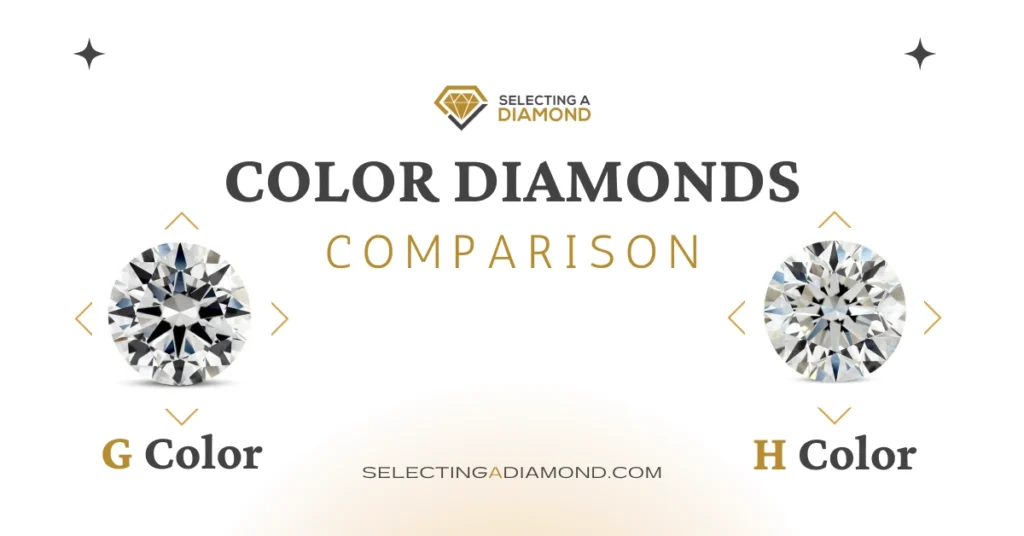
One grade of body color, and nothing else. Under lab lighting, face-down, against a master set, a trained grader separates them consistently. Face-up, in a setting, on a finger, nobody separates them at all. The difference you will actually experience as a buyer is the price you pay.
In twelve years of inspecting stones for readers, we’ve found the honest way to test this isn’t staring at photos. It’s a filtered search.
Lock everything: same shape, same cut grade, same clarity, same carat, same polish and symmetry, same fluorescence, same lab. Then flip color from G to H and watch which number moves. Only the price does.
You can run that exercise yourself on Blue Nile’s loose diamond search, filtering the two colors one after the other.
One warning about retailer imagery, because it trips people up. Those stones are shown at 20x or 40x magnification with lighting built to reveal every detail, so a faint tint on screen is not a tint your eye will ever meet. James Allen’s magnified 360-degree videos set the standard for that kind of inspection while the site existed, and they were never a preview of naked-eye color.
Are G Color Diamonds Colorless or Yellow?
Neither, strictly. G is graded near colorless, and it faces up white. Set in platinum or white gold, a G is not distinguishable from a D, E or F by eye. You need master stones for that call. GIA placed G exactly one step below colorless, and one step is invisible face-up.
That’s why a G is such a comfortable purchase psychologically. It reads as white, it certifies as near colorless, and it costs meaningfully less than the D–F group.
Fact: the word “colorless” is doing an enormous amount of marketing work in this industry. GIA named G–J “near colorless”, not “tinted”, not “slightly yellow”, not “lower quality”.
You probably heard a salesperson say that every single grade upgrade is a visible upgrade and worth every penny. That’s just BS.
For the price behavior and settings that suit this grade specifically, our full breakdown of G color diamonds goes grade-deep.
Is an H Grade Diamond Good Enough?
Yes: for most buyers H is the sweet spot of the whole scale. It’s the second near-colorless grade, it faces up white in white gold or platinum, and with every other spec held identical it costs less than G. We recommend starting a search at H and spending the difference on cut.
We’ve looked at thousands of stones from D through J over the years. H has never once been the thing that let a ring down.
What lets rings down is a mediocre cut on a big stone. That’s visible from the other side of a dinner table, and no color grade rescues it.
If you want the H grade examined on its own, including whether H ever looks yellow in fancy shapes, read our buying guide to H color grade diamonds.
What Does “G-H Color” Mean on a Diamond Listing?
A hyphenated pair like G-H means the seller is quoting a color range instead of one graded letter. You’ll see it on melee, on side stones, on uncertified goods and in mass-market jewelry copy. It tells you the stone falls somewhere in G or H, without committing to which.
For a center stone, that’s not good enough. Ask for the report and buy a single graded letter, because a range is a seller’s estimate rather than a lab’s finding.
Our guide to diamond certification covers which labs actually hold their grading tight.
Tip: on studs, a tennis bracelet or pavé side stones, a G-H spec is completely normal and nothing to worry about. Those stones are too small for a single grade to matter, which is why diamond earring listings on Blue Nile are commonly specced in color bands.
Can You Tell a Diamond’s Color by Just Looking?
No. Nobody names a diamond’s color grade with the naked eye (not you, not us, not a jeweler with thirty years behind the counter) without a known-color stone sitting right next to it. Gemologists grade face-down, against master sets, under fixed lighting. Guessing a letter across a table is not a skill anyone has.
Show an expert an E and an F and ask which is which. Watch what happens.
Non-adjacent grades don’t fix the problem either. Put a G beside a J and most people can see that one is warmer, but almost nobody can say how many grades apart they are.
There are three conditions under which a G and an H become separable at all. The two stones have to be together, side by side; the lighting has to be controlled rather than whatever the store installed; and there has to be a proper reference set to measure against.
Then, and only then, you might catch a slight difference. In a ring, on a hand, at dinner? Not a chance.
This is the part worth internalising. Color is a grade you buy on paper and a difference you never see, while cut is a grade you see every single time light hits the stone, which is why it’s the most important factor among the 4Cs.
Price Difference Between G and H Color Diamonds
H costs less than G with all other specs held constant, and the gap is real money rather than pocket change. On a 1 carat round with matched grades, the H price range came in up to roughly $600 below the G range when we ran the searches. That’s a cut upgrade, funded by an invisible grade.
Some of this traces back to the wholesale price sheets. Many years ago the Rapaport list treated the G-to-H step as large enough to justify a steep price break, and that decision still echoes through retail pricing today.
It caused plenty of argument among dealers and on diamond forums at the time, and rightly so. If the gap were $50, we’d tell you to stop reading and go take the G.
It isn’t $50. Here’s how we measured it.
We held these specs fixed for both searches: Excellent cut, VS2 clarity, 1 carat, Excellent polish and symmetry, no fluorescence, round shape, GIA certified. Only the color letter changed.
1. G Color Diamond Price Range
With those filters and color locked at G, the search on Blue Nile returned 73 diamonds when we ran it, priced from about $5.8k up to $8.4k once obvious outliers were trimmed.
You can reproduce the search with the same filters on the loose diamond search on Blue Nile and see how the range looks today.
2. H Color Diamond Price Range
Same seven filters, color moved down one step to H: 180 diamonds, running from about $5.5k to $7.8k. More stones, less money, one grade of color you cannot see.
Counts and prices move week to week as inventory turns, so treat these figures as the shape of the gap rather than today’s quote. The shape has been consistent for years.
So the question becomes simple. Is an invisible grade worth the better part of $600 to you?
Why H Color Is Enough for Most Buyers
Because the money buys nothing you can perceive, and the same money buys plenty elsewhere. H faces up white in white metal, sits in the same GIA group as G, and frees up several hundred dollars on a 1 carat stone. Three reasons carry the whole case.
1. You Cannot See the Grade You Paid For
An upgrade you can’t detect is a line on an invoice, not an improvement to a ring. Set both stones in platinum and the two look the same to every guest at the engagement party.
2. The Premium Is Real Money
Several hundred dollars on a single carat is not rounding. Scale it up to 1.5 or 2 carats and the same one-grade step costs considerably more, because color premiums grow with weight.
3. Color Is One Factor Out of Four
Cut, clarity, color and carat all compete for the same budget. Overspending on the one grade nobody notices means underspending on the one everybody notices, and that trade goes the wrong way.
Always secure the cut grade first, then spend what’s left on the other three.
G and H Color Diamonds: Shape and Metal Tips
Two decisions change how much color you can get away with: the shape of the stone and the metal it sits in. Round brilliants hide color best, step cuts show it most, and white metals mask a faint tint while yellow and rose gold push warmth into the stone regardless of its grade.
1. Shape
A round brilliant’s facet pattern bounces light so aggressively that body color gets diluted, which makes H a very comfortable choice there.
Emerald cuts behave differently. The large open table acts like a window into the stone, so warmth reads more easily. The same is true of Asscher, and princess sits somewhere in between.
The effect is easy to observe further down the scale. Compare a round and an emerald at the same grade and the emerald reads warmer every time, which our guide to I color grade diamonds shows grade by grade.
If you’re weighing shapes before you weigh colors, our roundup of the most popular diamond shapes is the place to start.
2. Metal Color
Platinum and white gold work in your favor, since a cool white metal gives the eye no yellow reference point beside the stone.
Yellow or rose gold does the opposite, and that’s fine. It just means paying for high color makes even less sense. In a warm setting you can drop to J color grade diamonds and the stone still looks right, because the metal is setting the tone anyway.
To see how the same stone reads in different metals, feel free to browse the platinum and white gold engagement ring settings alongside the yellow gold ones.
When You CAN Spot a Color Difference: Mismatched Labs
If you genuinely saw a difference between what a seller called a G and an H, the likeliest explanation is that the two stones were graded by different laboratories. Grading standards are not uniform. Two reports with the same letter on them can describe stones that are two or three grades apart.
An H from a loose lab beside a G from GIA is not a one-grade comparison at all. It only looks like one because both certificates use the same alphabet.
Our side-by-side on EGL vs GIA certificates shows how far that drift goes, and the EGL laboratory review explains why we tell readers to walk away from those reports entirely.
Buy the lab first, then the letter. A grade only means something if somebody strict assigned it.
Summary: Final Words on G vs H Diamond Color
Either grade is a good buy, and that’s the honest answer to “is G or H better?”. G is one step whiter on paper. H is the better value, and the two are indistinguishable once a stone is set and worn.
Our standing advice hasn’t changed in twelve years: don’t exceed H unless you have money left after the cut grade is secured. Above H you are paying for a certificate, not for a look.
Some buyers do love the idea of a colorless stone, and taste is allowed to be taste. Just know what the premium buys: scarcity and marketing, not visible whiteness.
Every extra dollar should have a visible effect on the stone in front of you. That’s the whole rule.
Remember, a diamond that stops you in your tracks got there through cut, and color grade only decides how much you had left to spend on it.
Frequently Asked Questions on G vs H Diamond Color
Is a G or H color diamond better?
G is one grade whiter, H is better value. Both are near colorless and both face up white in platinum or white gold, so we recommend H and putting the saved money into a higher cut grade.
What is the difference between a G and H color diamond?
Exactly one grade of body color on the GIA scale, plus a price gap that reached roughly $600 on a 1 carat round in our matched searches. Visually, the two are separable only side by side against master stones.
Are H color diamonds yellow?
No. H is the second grade of GIA’s near-colorless group and it looks white face-up, especially in round shapes and white metal settings. Any warmth becomes noticeable only in large step cuts like emerald or Asscher.
What does G-H color mean on a diamond?
It means the seller is quoting a color range rather than one graded letter, so the stone falls somewhere in G or H. It’s standard on melee, side stones and small studs, and it’s not acceptable for a certified center stone.
Is a G colour diamond the same as a G color diamond?
Yes, it’s the same grade with British spelling. GIA’s letters are identical worldwide, so a G colour diamond in the UK or Australia is graded the same way as a G color diamond in the US.
Is an H grade diamond good for an engagement ring?
Yes, and it’s our default recommendation. H gives you near-colorless certification, a white face-up appearance and several hundred dollars back on a 1 carat stone compared with G.
Should I choose G or H for a yellow gold setting?
Neither: you can go lower. Yellow and rose gold reflect warmth into the stone regardless of grade, so I or J will look right in a warm setting and paying for G makes no visual sense.
Still not sure where to buy your diamond?
We always recommend shopping diamonds online, and we wrote a full guide to shop diamonds like a pro to walk you through it step by step.
Among online retailers, Blue Nile is the store we point readers to: a very wide loose diamond inventory across every size, solid imaging on most of it, and filters precise enough to run the G-versus-H comparison yourself in a couple of minutes.
If you’d rather compare stores first, read our buying diamonds online comparison.