We may earn a commission when you purchase through our affiliate links, at no extra cost to you. This helps support our work and allows us to continue providing unbiased, expert diamond advice.
Note: Most prices, product details, or comparisons mentioned in this article are based on information available from our trusted partner we frequently reference: Blue Nile. We may earn a commission when you purchase through our affiliate links, at no extra cost to you. This helps support our work and allows us to continue providing unbiased, expert diamond advice.
Summary in a few lines:
- Oval is the second most popular diamond shape for engagement rings, sitting right behind the round brilliant.
- An oval faces up larger than a round of the same carat weight, so you buy visible size rather than hidden weight.
- Almost every oval carries a bow tie shadow; a faint one is invisible at arm’s length and should NOT cost you a stone you love.
- The last time we priced a 1 carat oval (G color, VS2 clarity, excellent cut) on Blue Nile, the range ran $4,038 to $6,900; at 2 carat with matching specs it ran $22,971 to $28,472.
- Solitaire, hidden halo and thin pavé bands are the three looks Pinterest saves most, and all three are stock settings, not custom work.
What does an oval ring say about you? Innovative, unique, sophisticated, and powerful.
An oval cut diamond is a stretched round brilliant, and that one change of outline is why the shape keeps winning: more finger coverage, a longer looking hand, and sparkle that sits only a hair behind a round.
Pinterest is where most people meet the shape. This guide covers what the pins never tell you: ratio, bow tie, color, price, and what happens when the ring arrives.
What Is an Oval Cut Engagement Ring?
An oval cut engagement ring is built around a modified brilliant diamond: the same faceting logic as a round, stretched along one axis. It sparkles nearly as hard as a round, covers more finger for the same carat weight, and makes the hand read longer and slimmer. Second most popular engagement shape, behind round.
The elongated outline is doing all the work here. Because weight is spread across a longer surface instead of packed into depth, a well cut oval simply looks bigger on the hand than its carat weight suggests.
Do oval cut rings sparkle? Yes, and strongly. The long facets throw wide flashes of light rather than the tight pinfire of a round, which is exactly why ovals photograph so well.
Oval centers appear in nearly every setting family: solitaire, halo, hidden halo, pavé, three-stone, bezel, east-west. If you want the full menu before you shop, our guide to engagement ring styles and settings types walks through each one.
So why does this one shape flood every board you open? Let’s look at that.
Why Do Oval Rings Dominate Pinterest?
Ovals dominate Pinterest because they photograph better than any other shape. The long outline fills more of a vertical thumbnail, the silhouette is recognisable at a glance, and the stretched facets throw big flashes under ring-light photography. A round reads as “a diamond”; an oval reads as “a choice”.
There is a catch, and it matters to your budget. The rings that get saved thousands of times are usually 3 carat and up, shot from six inches away on a slim hand.
Pinterest is a mood board, not a price list. Save the setting, ignore the stone size, then price the setting with a carat weight you can actually pay for.
Tip: most pins are unlabelled or link to a dead page. Search by style name instead (“oval hidden halo”, “oval French pavé”, “oval three-stone”) and you will find the same look in stock inventory in about a minute.
That is how we shop the boards ourselves. Pick the pin, name the style, then match it against real listings such as Blue Nile’s oval engagement ring settings to see what the same design costs with a stone you can afford.
Saving pins is the easy part. Judging the diamond inside them is where people lose money.
How Do You Judge an Oval Cut Diamond?
Judge an oval on five things, in this order: cut quality, length-to-width ratio, bow tie strength, color, and clarity. GIA does NOT issue an overall cut grade for fancy shapes, so no certificate will tell you an oval is beautiful. You judge that with your own eyes, on video.
1. Cut Quality and Proportions
Since there is no cut grade to lean on, read the table and depth percentages on the report and then watch the stone rotate. You are looking for even light return across the whole face, not a bright head with two dull ends. Our guide to the best diamond table and depth percentages gives the ranges worth targeting.
2. Length-to-Width Ratio
Divide the length by the width and you get the ratio. Most ovals on the market land between 1.35 and 1.50, where 1.35 looks plump and 1.50 looks distinctly elongated.
Here is the part nobody says out loud: the gap between 1.40 and 1.45 is invisible on a hand. Pick the look you like on video and stop optimising a decimal.
3. Shoulders and Outline
Avoid ovals with pointy or flat-sided shoulders. The curve should be smooth and continuous from tip to tip, with no straight edge and no sudden pinch, because an uneven outline is the one flaw a setting cannot hide.
4. Color
Ovals hold a touch more warmth at the two ends than rounds do, since the elongated shape concentrates body color at the tips. A G color diamond is the safe stopping point for a white setting. In yellow or rose gold, you can drop lower and lose nothing.
5. Clarity
Ovals hide small inclusions reasonably well, though the wide open table can expose a dark crystal sitting dead center. Eye clean is the target, not a grade letter. Plenty of stones at SI1 clarity are eye clean and cost meaningfully less than VS2.
Once those five are settled, you can filter the rest yourself: feel free to set shape to oval on Blue Nile’s loose diamond search and watch a dozen stones rotate before you shortlist anything.
Oval vs Round Diamond Cuts
Round wins on raw brilliance. Oval wins on visible size per dollar. For matched color, clarity and cut quality, an oval costs less than a round of the same carat weight and looks larger on the finger, while the round returns light more evenly and hides body color slightly better.
1. Brilliance
The round brilliant is the most brilliant shape ever cut, and nothing else is close on paper. An oval carries most of that sparkle with a longer, softer flash pattern. Side by side on a hand, most people notice the shape first and the brilliance second.
2. Size on the Finger
This is the oval’s real argument. Spread across a longer outline, a 1 carat oval covers noticeably more skin than a 1 carat round, so buyers who want presence get it without paying for the next carat bracket.
3. Color
Rounds mask warmth better across the color scale. Ovals show a little tint at the tips, which is why an I color grade diamond that looks fine as a round may look faintly warm as an oval in platinum.
4. Price
Rounds cost more, full stop. Cutting a round wastes more rough, and global demand keeps the premium in place, so an oval of matching 4Cs comes in below it.
5. Popularity
Round is still the most requested shape by a wide margin. Oval is the challenger, and it has been climbing for years, which is why it appears on every list of current engagement ring trends.
If you are still torn between outlines, our breakdown of how to choose the best diamond shape for an engagement ring lines up all eight of the popular ones. And if brilliance is your only priority, which diamond shape is best for brilliance answers that directly.
8 Oval Ring Styles Worth Saving
Eight settings account for nearly everything saved under oval engagement rings: solitaire, hidden halo, pavé, halo, three-stone, two-stone, east-west, and bezel. All eight exist as stock settings, so none of them requires a custom quote. Pick the one that suits the hand, then drop your stone into it.
1. Solitaire
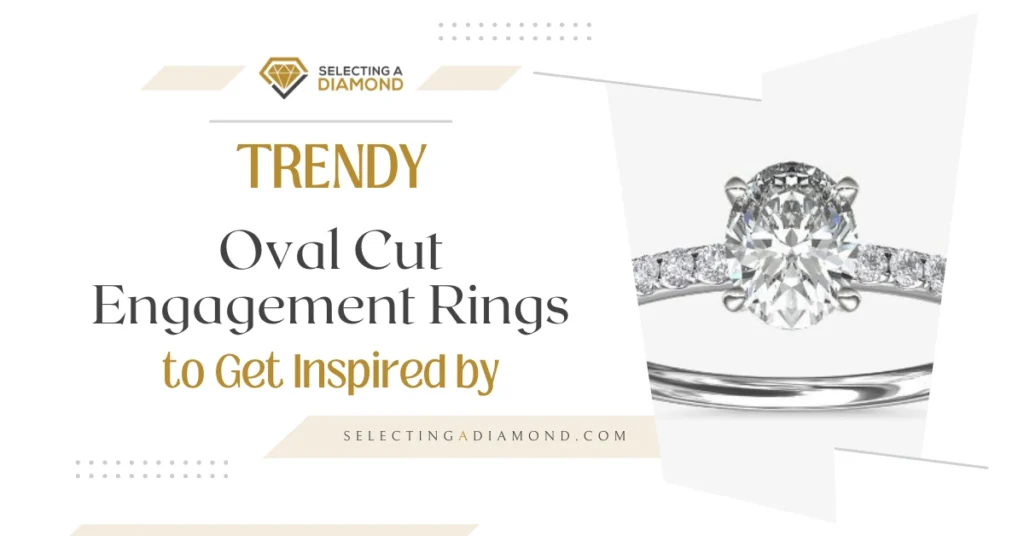
One oval, one thin band, nothing else. It is the most photographed engagement ring on the internet for a reason: the shape gets the whole stage. A petite band in 18k yellow gold makes the stone look larger than the same stone on a thick shank.
2. Hidden Halo
A ring of tiny diamonds sits under the center stone, out of sight from above. From the top it reads as a solitaire. From the side it sparkles like a halo, and it lifts the oval high enough to clear a wedding band cleanly.
3. Pavé and French Pavé Bands
Small diamonds run along the shank and pull light up toward the center. French pavé cuts a V-shaped groove under each melee stone so more of it shows, which makes the band brighter without making it wider.
4. Halo
A full halo of melee circles the oval and adds visible millimetres. This is the setting that makes a 1 carat center read like something bigger, and it flatters both long and short fingers.
5. Three-Stone
An oval flanked by two side stones, usually pear, trapezoid or tapered baguette. The look is formal and it suits a larger center. Keep the side stones within one color grade of the middle or the mismatch shows.
6. Two-Stone
Two stones sit side by side on an open shank, often an oval paired with a cushion or a pear. It is unconventional, it photographs beautifully, and it is very much a personal-taste ring rather than a safe surprise proposal.
7. East-West Oval
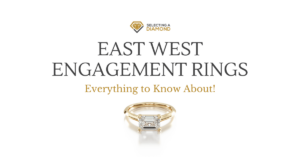
Turn the oval sideways so it lies across the finger instead of along it. The effect is modern and slightly architectural, and it suits people who find the vertical solitaire too traditional. We cover the whole style in our guide to east west engagement rings.
8. Bezel and Vintage Engraved
A bezel wraps metal around the girdle, which protects the tips and gives a clean, workwear-friendly profile. Engraved or milgrain shanks push the same oval in the opposite direction, toward antique. Both settings are quietly practical for anyone who works with their hands.
Whichever of the eight you save, we found the fastest way to compare them honestly is to view the same carat weight in each: feel free to switch settings on Blue Nile’s oval engagement ring collection and watch the stone size stay fixed while the look changes.
The Bow Tie Effect in Oval Diamonds
A bow tie is the dark band across the middle of an oval where facets return no light to your eye. Nearly every oval has one. A faint bow tie is invisible at arm’s length and is not a reason to reject a stone; a heavy black one kills the center of the diamond and you should walk away from it.
In twelve years of pulling stones up on video for readers, we have never seen an oval with zero shadow. The shape’s geometry guarantees some of it.
The honest test is simple. Watch the 360 video at normal zoom, not at 40x, because magnification exaggerates a shadow you would never notice on a hand in a restaurant.
Remember this: if the bow tie disappears when the stone tilts and the center stays bright most of the time, the diamond is fine. If the band stays black through the whole rotation, move on to the next one.
Our full breakdown of the bow tie effect in oval diamonds shows what mild, moderate and severe actually look like.
Are Oval Cut Diamonds More Expensive Than Round?
No. For matched color, clarity and cut quality, an oval costs less than a round of the same carat weight, because rounds waste more rough during cutting and carry heavier demand. The saving is real, though it is not dramatic, and it vanishes the moment you use it to chase a bigger stone.
Some numbers to anchor it. The last time we priced a 1 carat oval with G color, VS2 clarity and an excellent cut on Blue Nile, the range ran $4,038 to $6,900.
At 2 carat with the same specifications, the range ran $22,971 to $28,472. Doubling the carat weight far more than doubles the bill, and that is true for every shape, not just ovals.
Those figures move with the market, so treat them as a shape of the curve rather than today’s tag. Feel free to check the current spread yourself by filtering shape, color and clarity on Blue Nile’s loose oval diamond search.
Before you set a number, two pages are worth ten minutes: how much to spend on an engagement ring, and the best time to buy diamonds and engagement rings.
Matching a Wedding Band to an Oval Engagement Ring
Three approaches work with an oval: a contoured band that curves around the stone, a plain straight band worn flush, or a matched pavé band from the same setting family. Ovals sit tall and have no sharp points at the sides, so a straight band usually tucks in without a gap, unlike marquise or pear.
The stacked oval-plus-thin-band photo is one of the most saved wedding ring images anywhere, and it is easy to copy. Keep the metals identical and keep the band narrower than the shank of the engagement ring.
Height is the thing people forget. A low-set solitaire and a chunky band will fight each other, while a hidden halo lifts the stone enough that almost any band slides underneath.
If you want the mechanics of pairing, read how to match engagement ring and wedding band, and then the engagement ring and wedding band rules that are safe to ignore. To see straight and contoured profiles side by side, feel free to browse Blue Nile’s wedding rings.
Where Should You Buy Oval Cut Engagement Rings?
Buy where you can watch the actual stone rotate on video before you pay, because an oval cannot be judged from a spec sheet. Blue Nile is the retailer we point readers to now: large loose oval inventory, GIA reports on the certified stones, and video on most of what they list, plus stock settings for every style above.
James Allen’s imaging was the other benchmark for years, and the brand still shows up in searches for oval rings. It shut down in August 2026, and the collection now lives inside Blue Nile, so there is nothing left to link there.
The method matters more than the logo. Pick the loose oval first on video, then drop it into a setting, rather than buying a finished ring where the center stone is a spec line you never saw move.
Put simply, if you cannot watch the bow tie behave, you are guessing. For the wider picture of the store itself, read our Blue Nile diamonds and jewelry review, and if this is your first ring purchase, start with the pillar: 6 things you should know before buying an engagement ring.
Summary: Final Words on Oval Cut Engagement Rings
An oval engagement ring buys you visible size, an elongated hand, and a shape that photographs like nothing else. That is why it owns Pinterest, and that is why it has held second place behind the round brilliant for years.
Judge the stone in this order: cut quality and proportions, then ratio, then bow tie, then color, then clarity. No certificate will grade the beauty of a fancy shape for you.
Ignore the decimal points that no one can see. A ratio of 1.42 against 1.45 changes nothing, and a faint bow tie changes nothing either.
Expect to pay less than you would for a round of the same weight and specs, and expect the jump from 1 carat to 2 carat to be brutal rather than double.
Remember, each oval is cut by hand and no two behave the same on video. Watch it move, then buy the one you keep going back to.
Frequently Asked Questions on Oval Cut Engagement Rings
Why are oval engagement rings so popular on Pinterest?
Because the shape photographs better than any other. The long outline fills a vertical thumbnail, the silhouette is recognisable at a glance, and the stretched facets throw wide flashes under ring lighting. Most viral pins also use a 3 carat or larger stone on a slim hand, which exaggerates the effect.
Do oval cut diamonds sparkle as much as round diamonds?
Almost. The round brilliant returns light most efficiently of any shape, and the oval sits just behind it with a longer, broader flash pattern instead of tight pinfire. On a hand in normal light, most people notice the outline before they notice the difference in brilliance.
What length-to-width ratio is best for an oval diamond?
There is no perfect ratio. Most ovals sell between 1.35 and 1.50, with 1.35 looking rounder and fuller and 1.50 looking distinctly elongated. Differences of a few hundredths are invisible on a finger, so choose the outline you prefer on video rather than a target number.
Are oval diamonds cheaper than round diamonds?
Yes, for matched color, clarity and cut quality at the same carat weight. Rounds waste more of the rough crystal during cutting and carry the highest demand of any shape, so they hold a price premium. An oval also faces up larger, which stretches the saving further.
Do all oval diamonds have a bow tie?
Practically all of them do. The bow tie is a dark band across the center caused by facets returning no light, and the elongated geometry makes it unavoidable. Faint ones are invisible at normal viewing distance. Reject only the stones where the shadow stays black through the whole rotation.
Can you still buy a James Allen oval ring?
Not from James Allen directly. The brand shut down in August 2026 and now exists as a collection inside Blue Nile, so old product links no longer resolve. Search the same style names, solitaire, hidden halo, petite pavé, and you will find equivalent oval settings in current inventory.
Which color grade should you choose for an oval diamond?
G is the safe stopping point in white gold or platinum, since ovals concentrate a little warmth at the two tips. In yellow or rose gold you can comfortably drop to H, I or lower, because the metal casts warmth onto the stone anyway and the saving is significant.
Still not sure where to buy your diamond?
We always recommend shopping diamonds online, and we wrote a full guide to shop diamonds like a pro to make that easier.
Among online retailers, Blue Nile is the one we send readers to: a very wide loose diamond collection across every shape and size, video on most of the inventory, GIA reports on the certified stones, and settings for every oval style covered above.