We may earn a commission when you purchase through our affiliate links, at no extra cost to you. This helps support our work and allows us to continue providing unbiased, expert diamond advice.
Note: Most prices, product details, or comparisons mentioned in this article are based on information available from our trusted partner we frequently reference: Blue Nile. We may earn a commission when you purchase through our affiliate links, at no extra cost to you. This helps support our work and allows us to continue providing unbiased, expert diamond advice.
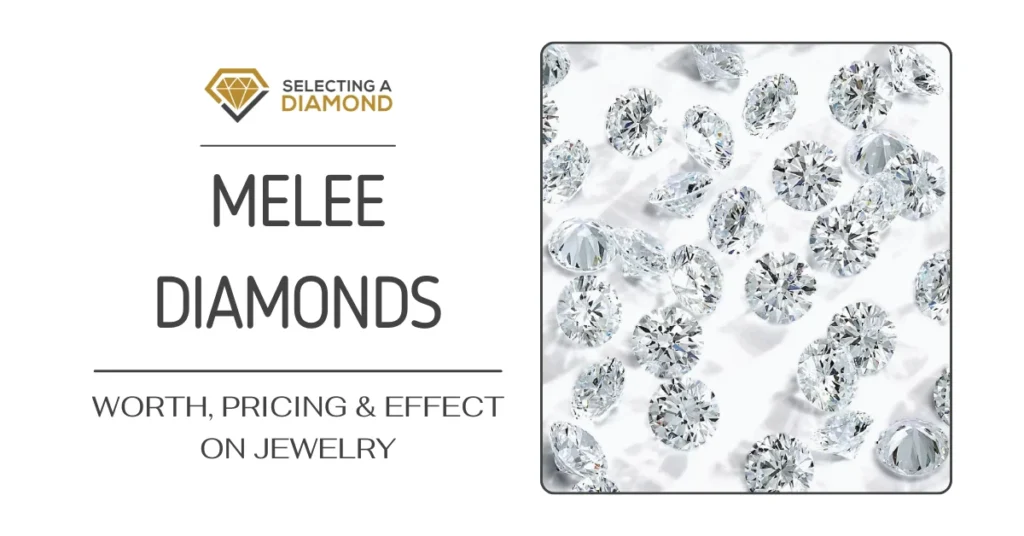
Melee diamonds (pronounced meh-lee) are the small stones doing the quiet work in most of the diamond jewelry you have ever admired.
They are not the headline. They are the halo around the headline, the row running down the shoulders of a band, the glitter that makes a modest center stone read as bigger and brighter than it really is.
Let’s get an insider look at these tiny gems: what they are, how they are priced, and what they are actually worth.
Summary in a few lines:
- GIA defines a melee diamond as any diamond under 0.2 carats, and they run down to roughly 0.001 carats.
- They are sold by the parcel in total carat weight, not one stone at a time, so there is no retail price for a single melee diamond.
- Single cut melee carries 17 or 18 facets; full cut melee carries 57 or 58, and almost everything in a modern ring is full cut.
- A ring totalling 1.50 carats tcw in small stones costs far less than a solitaire holding one 1.50 ct diamond.
- Melee has almost no standalone resale value, its worth lives in the piece it is set into.
Table of Contents / Toggle
What Are Melee Diamonds?
Melee diamonds are any diamonds weighing less than 0.2 carats, which is the cut-off used by the Gemological Institute of America (GIA). They can go as small as about 0.001 carats. Their job is accent work: filling a halo, lining a pavé band, or sitting in a channel alongside a larger center stone.
You will find them in halo, pavé, channel and cluster settings. You will almost never find one used as a solitaire center stone, and that is the whole point of them.
On its own, a single melee stone is worth very little. Together, twenty or forty of them change how a ring reads from across a room, which is exactly why designers keep reaching for them.
Fact: the word comes from the French for a scuffle or a crowd. That is a fair description of how these stones are handled in the trade: in crowds, by the parcel, never one at a time.
Star Diamonds vs. Melee Diamonds
Star is a size class inside melee, not a different kind of stone. Dealers call the very smallest goods, roughly under 0.01 carat, “stars”, and keep “melee” for the sizes above that up to the 0.2 carat ceiling. To GIA, both are simply melee. The split exists so parcels can be sieved, sorted and priced.
Sieve sizes and the exact boundary vary from one dealer to the next, so treat the star/melee line as a trade habit rather than a graded standard.
For a buyer standing at a counter, the distinction changes nothing at all. What matters is whether the small stones in front of you are matched in color and set straight.
How Are Melee Diamonds Cut? Single Cut vs Full Cut
Melee comes in two cuts. Single cut melee carries 17 or 18 facets and reads bright but calm. Full cut melee carries 57 or 58 facets, the same layout as a standard round brilliant, and it throws far more fire. Almost every melee stone in a modern ring is full cut.
A single cut stone has 8 facets on the crown, 8 on the pavilion, plus the table. That was the sensible choice back when placing 58 facets on a stone that tiny cost more than the stone was worth.
Cutting technology moved on. Single cuts now turn up mainly in vintage and antique-style pieces, or in restoration work where the new stones have to match what is already there.
Full cut melee is what gives a pavé band that continuous, restless sparkle. If you want the facet logic behind that, our guide on why round diamonds sparkle more lays out the pattern.
Melee Diamond Pricing: Per Carat, Not Per Stone
Melee is priced per carat and sold in parcels by total weight, never per stone at retail. What moves the per-carat price is sieve size, the color and clarity range of the parcel, cut quality, and how well the stones are matched to each other. Larger parcels bring the cost per carat down.
We are not going to print a per-carat figure here. Melee prices shift with sieve size, with the quality range inside the parcel, and with the market; any number we quoted today would quietly mislead you six months from now.
What does hold steady is the shape of the math. Melee per carat sits far below what a single stone of the same weight commands, because rarity climbs sharply with size.
Our diamond price per carat guide walks through that curve, and the 1 carat diamond price breakdown shows you the other end of it.
One practical note: melee is not sold to consumers a stone at a time. Feel free to browse Blue Nile’s loose diamond search and you will notice the inventory there is center-stone material, not accent goods.
Are Melee Diamonds Worth Anything?
Yes, but the value lives in the piece rather than in the stone. A matched parcel of melee has genuine wholesale value by the carat. A single melee diamond prised out of a ring is worth close to nothing on its own, because sorting, matching and handling it costs a buyer more than the diamond does.
That is the blunt answer to the question people ask most about them. Melee buys you design value and apparent size, not resale value.
In twelve years of inspecting stones for readers, we’ve found that shoppers who worry about the resale of their accent stones are asking the wrong question. Center stone quality and metal weight are what a buy-back offer is really built on; the melee gets rounded into the number.
If you want the wider picture on that, read our guide to how much value a diamond loses after purchase.
Melee Diamond Buyers: Who Actually Buys Them
Melee is bought by jewelry manufacturers, setters, designers and parcel dealers, almost always at trade level and almost always by the carat. Consumers essentially never buy loose melee. If you are selling an old piece, expect the buyer to value the accents as an estimated total carat weight at a low per-carat rate.
Some buyers will not price the melee separately at all; they fold it into the offer for the piece as a whole.
That is normal, and it is NOT a scam. Unsetting, cleaning, sorting and re-selling forty tiny stones is labour that eats most of the value those stones carry.
Planning to sell something? Our walkthrough on how to sell an engagement ring covers what a buyer weighs first, and in what order.
Melee Diamonds Grading and the 4Cs
Melee almost never receives an individual grading report, because the lab fee would cost more than the diamond. Parcels are graded as a group against a stated range instead, something along the lines of “G-H color, VS-SI clarity”. As a buyer you get a quality range for the accents, not a certificate number to look up.
Cut, color and clarity still matter to how the finished piece looks. They simply cannot be audited stone by stone.
Here is the part that matters less than buyers fear: a half-grade of color drift between two accent stones is invisible at arm’s length. What you will notice is one stone sitting crooked, one reading duller than its neighbours, or a visible gap in the row.
If a jeweler starts quoting a lab name for the accents, read it carefully against our guide on which grading lab is the best. For the color side, the diamond color chart shows how far apart two grades have to be before your eye catches the difference.
Carat Weight (CT) vs Total Carat Weight (TCW)
Carat weight is the weight of one diamond, usually the center stone. Total carat weight (tcw) is every diamond in the piece added together, melee included. They are not interchangeable, and the gap between the two is where a lot of shoppers end up confused about what they actually bought.
For example: a ring built from multiple small diamonds totalling 1.50 carats tcw is priced well below a solitaire holding a single 1.50 ct stone.
The reason is simple. Large rough is rarer, so price per carat climbs steeply with size, and twenty small stones will never cost what one big stone does at the same total weight.
So read the spec line closely. If a listing quotes only tcw and never names a center stone weight, the piece is probably mostly melee. Our diamond pricing guide shows how the 4Cs stack up into the final number.
Popular Settings That Use Melee Diamonds
Melee turns up in halo settings encircling a center stone, in pavé bands, in channel settings between two strips of metal, on three-stone shoulders, and across eternity bands, tennis bracelets and halo studs. Anywhere a design calls for continuous sparkle instead of one big flash, melee is doing the work.
The halo is the clearest demonstration of all. Ring a 0.70 ct center stone with melee and it reads on the hand like something noticeably larger, for a fraction of what that extra weight would cost in one stone.
Want to see the effect side by side? Feel free to browse Blue Nile’s engagement rings and set a plain solitaire next to a pavé or halo design at a similar total weight.
The same trick runs through the rest of the jewelry box. Diamond wedding and eternity bands are essentially melee held in a straight line, and many diamond tennis bracelets are the same idea stretched around a wrist.
5 Tips Before Buying a Ring With Melee Diamonds
Judge the group, not the individual stone. Since melee is never graded one by one, check the uniformity of color and size, look hard at how securely each stone is seated, ask where the diamonds were sourced, and get a second opinion before paying for heavy pavé work. Those five checks catch nearly every problem.
1. Examine the Overall Appearance
Hold the piece at arm’s length first, then bring it in close. If the row of accents looks even and lively from normal viewing distance, it is doing its job. Nobody is going to loupe your shoulders at dinner.
2. Seek Uniformity
Look along the row for a stone that is fractionally larger, warmer or flatter than the rest. One mismatched accent is far more visible than a whole parcel that sits a grade lower. Uniformity beats quality here, every time.
3. Ask About Sourcing
Ask where the small stones came from and whether the seller can stand behind that answer. Melee travels through more hands than a center stone does, which makes provenance a fair question. Our guide to conflict-free diamonds covers what a credible answer sounds like.
4. Check the Quality of the Setting
Run a fingernail gently over the pavé. Anything that snags, wobbles or catches suggests a bead or prong that will surrender a stone within a year. This is the single most common failure point in melee-heavy jewelry.
5. Get Professional Advice on Detailed Work
For a piece with a great deal of melee detailing, a trusted jeweler or gemologist is worth the twenty minutes. They will spot a replaced stone, a lazy setting job, or an accent that is not a diamond at all. Ask before you pay, not after.
Summary: Final Words on Melee Diamonds
Melee diamonds are small but structural. Under 0.2 carats each, they accent a center stone, build halos and pavé, and carry a huge amount of a design’s visual impact.
They are priced per carat in parcels, graded as groups rather than individuals, and worth very little once separated from the piece they were set into.
So spend your attention where it pays: the center stone, the uniformity of the accents, and the quality of the setting holding them all in place. Our guide on how to buy loose diamonds covers the grades that actually earn their money.
Remember, melee is a supporting cast. Cast it well and nobody notices it, which is precisely the compliment it is after.
Frequently Asked Questions on Melee Diamonds
What is a melee diamond?
A melee diamond is any diamond weighing less than 0.2 carats, per GIA’s definition. Sizes run down to roughly 0.001 carats. They are used as accent stones in halos, pavé bands, channels and clusters rather than as center stones.
How much do melee diamonds cost per carat?
Melee is quoted per carat and sold in parcels, with the price driven by sieve size, the color and clarity range, cut quality and how well matched the stones are. Per carat it sits far below a single stone of the same total weight, and the figure moves with the market, so ask your seller for a current parcel price.
Are melee diamonds worth anything?
As a matched parcel, yes, they carry real wholesale value by the carat. As a single loose stone pulled from a ring, almost nothing, because handling and sorting costs more than the diamond. Their value is design value inside the finished piece.
What is the difference between star and melee diamonds?
Star is a trade sub-category for the smallest melee, generally under about 0.01 carat, while melee covers everything up to 0.2 carats. Both are melee under GIA’s definition. The boundary varies between dealers, so it is a sorting convention rather than a grading standard.
Do melee diamonds come with a certificate?
Individually, no. A lab report would cost more than the stone, so melee is assessed in groups against a quality range such as “G-H, VS-SI”. The center stone of a ring should be certified; the accents will not be.
Who buys melee diamonds?
Jewelry manufacturers, setters, designers and parcel dealers buy melee, almost always at trade level and by total carat weight. Consumers do not buy loose melee. If you are selling a piece, most buyers fold the accent stones into one overall offer.
Are melee diamonds real diamonds?
Yes. Melee describes a size class, not a material, so a melee diamond is a real diamond that happens to weigh under 0.2 carats. It can be mined or lab-grown, and it is graded on the same 4Cs, just in parcels rather than one stone at a time.
Still not sure where to buy your diamond?
We always recommend shopping diamonds online, and we put together a full guide on how to pick a good diamond before you spend a cent.
Among online retailers, Blue Nile is the store we keep coming back to: the widest collection of loose diamonds across every size, solid imaging on most of their inventory, and helpful customer support when you need a second pair of eyes.