We may earn a commission when you purchase through our affiliate links, at no extra cost to you. This helps support our work and allows us to continue providing unbiased, expert diamond advice.
Note: Most prices, product details, or comparisons mentioned in this article are based on information available from our trusted partner we frequently reference: Blue Nile. We may earn a commission when you purchase through our affiliate links, at no extra cost to you. This helps support our work and allows us to continue providing unbiased, expert diamond advice.
An engagement ring carries more symbolism than anything else you will ever buy, which is why the stone in the middle of it deserves a real decision rather than a default one. It stands in for a relationship. It also says something about the person wearing it.
Two things decide whether a center stone was a good call: beauty and durability. Beauty is color, brightness, shape and size. Durability is hardness, toughness and stability, and most buyers only ever hear about the first one.
Summary in a few lines:
- Sapphire and ruby are the two strongest diamond alternatives for daily wear, both scoring 9 on the Mohs scale.
- Moissanite sits at 9.25 and throws more colored fire than a diamond does, at a fraction of the price.
- Emerald, aquamarine and spinel land at 7.5 to 8, so they are beautiful but need a protective setting.
- Hardness is only one third of durability, and toughness is the part that actually breaks stones.
- Diamond is still the only gem at a perfect 10, and it remains the safest pick for a ring that never comes off.
Table of Contents
Toggle
What Are the Best Gems for Engagement Rings?
Sapphire and ruby are the best gems for engagement rings after diamond. Both score 9 on the Mohs scale, both shrug off daily knocks, and both come in colors no diamond can match at the same price. Moissanite is the strongest budget alternative at 9.25. Emerald, aquamarine, spinel and topaz are gorgeous but softer, and they need gentler settings.
The trade splits stones into “precious” and “semi-precious”, a piece of Victorian marketing that tells you nothing about how a gem behaves on a hand. Spinel is called semi-precious. It outlasts emerald easily.
So ignore the label and read the three numbers that matter: hardness, toughness, and price per carat.
Why Is Diamond Still the Default Center Stone?
Diamond is the only gemstone that scores a perfect 10 on the Mohs scale, and nothing in normal life will scratch it. GIA grades color from D (colorless) to Z (light yellow or brown), and colorless stones return the most light to the eye. Price moves with all four Cs, but cut moves it hardest.
That hardness is why a diamond looks the same after ten years of dishes, car doors and gym bags. Softer stones go cloudy at the facet junctions long before they crack.
Diamond is also the only stone on this page with a public, standardized grading system behind it, which means you can compare two listings honestly. Colored gems have no equivalent scale. You are judging those with your eyes.
Tip: if you want to watch the 4Cs move a price in real time, hold three of them still and change one. The loose diamond search on Blue Nile lets you do exactly that, and it is the fastest lesson in diamond pricing there is.
If diamond is where you land, the next decision is shape, and we’ve covered the best diamond shape for an engagement ring in full.
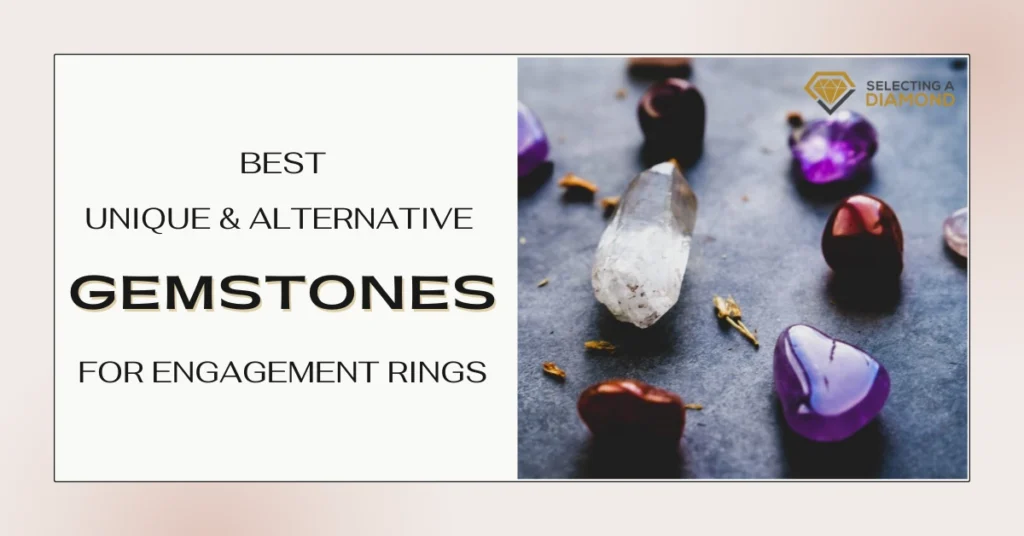
7 Alternative Gemstones for Engagement Rings
Ranked by how well they survive a hand: moissanite at 9.25, sapphire and ruby at 9, topaz at 8, spinel at 7.5 to 8, aquamarine at 7.5 to 8, and emerald at 7.5 to 8. The top four handle daily wear without special treatment. The bottom three are for people who take a ring off to cook and clean.
1. Moissanite
Moissanite is lab-created silicon carbide, and at 9.25 on the Mohs scale it is the second hardest stone you can reasonably set in a ring. Its dispersion is 0.104 against a diamond’s 0.044, which in plain terms means it throws far more rainbow fire. Some people love that. Some find it obviously non-diamond in bright sun.
Price is the headline. A moissanite of the same size costs a small fraction of a natural diamond, which is why it dominates the alternative market. If you want the full side-by-side, read our comparison of moissanite vs diamonds.
2. Sapphire
Sapphire’s classic color is a deep, saturated blue, but the mineral also shows up in pink, yellow, green, purple and colorless. At 9 on the Mohs scale it is the hardest natural gem after diamond. Nothing you own at home will scratch it.
The most valuable blue sapphires are vivid rather than dark, and a stone that reads “inky” in the shade is usually overpriced for what it is. Cost sits below diamond at comparable sizes. If blue is the direction, our guide to blue sapphire wedding rings covers the settings that suit it.
3. Ruby
Ruby is the same mineral as sapphire, corundum, simply colored red by chromium instead of blue by iron and titanium. That means the same 9 on the Mohs scale and the same excellent resistance to scratching. The best rubies run vivid pinkish-red through to deep red, with strong saturation.
Rubies of real quality can cost more per carat than many colored stones, and untreated material in larger sizes is genuinely rare. Most rubies on the market are heat-treated, which is standard and stable. See our picks for natural ruby rings for women if red is the plan.
4. Topaz
Topaz comes in blue, pink, yellow, peach and colorless, and blue topaz is the version most people put in a ring. It scores 8 on the Mohs scale, so scratching is not the problem here. Cleavage is.
Topaz has perfect basal cleavage, meaning a sharp knock in the wrong direction can split it along a flat plane rather than chip a corner. That is a real risk on a ring worn every day, and it argues for a bezel or a protected setting. Topaz is also one of the cheapest stones on this list, so the math is friendly.
5. Spinel
Spinel runs from vivid red and hot pink through to blue, purple and grey, and a few stones shift color under different lighting. It sits at 7.5 to 8 on the Mohs scale with no cleavage worth worrying about, which makes it tougher in practice than its number suggests.
Random fact: the “Black Prince’s Ruby” in the British Imperial State Crown is a spinel, and it fooled royalty for roughly four centuries. Prices depend heavily on color, and fine red spinel is no longer the bargain it was a decade ago.
6. Aquamarine
Aquamarine is the pale blue member of the beryl family, ranging from an almost translucent sky tone to a deeper, more saturated blue. Hardness is 7.5 to 8. Unlike its cousin emerald, aquamarine is usually clean, so you get an untroubled, glassy stone.
It is also one of the most affordable ways to get real size on a hand, because large clean crystals are not rare. The catch is saturation: pale aquamarine can wash out under office lighting, and bigger stones hold color better than small ones.
7. Emerald
Emerald’s rich green is the reason people forgive everything else about it. On paper it scores 7.5 to 8, which sounds fine. In reality it is the most fragile stone on this page, because emeralds are heavily included and almost always oil-treated to soften the look of those fractures.
That is why the step-cut shape with the clipped corners was invented for it, and why the same outline now shows up on diamonds in emerald cut engagement rings. Prioritize color and clarity over carat weight here. A smaller, cleaner emerald beats a big cloudy one every time.
What Does the Mohs Hardness Scale Actually Tell You?
The Mohs scale ranks one thing only: resistance to scratching. Talc sits at 1, diamond at 10, and each mineral scratches everything below it. What the scale does not tell you is by how much, because the steps are not evenly spaced. Diamond is many times harder than corundum despite being one number above it.
Practical translation: household dust contains quartz at around 7. Anything below 7 will slowly frost over from being wiped with a cloth, year after year.
That single fact rules out a long list of pretty stones for engagement rings. It also explains why sapphire and ruby have survived as alternatives for centuries while opal and pearl have not.
Is Hardness the Same as Durability?
No. Gemologists split durability into three parts: hardness, toughness and stability. Hardness is scratch resistance, toughness is resistance to breaking and chipping, and stability is resistance to heat, light, chemicals and humidity. A stone can be very hard and still snap, which is exactly what catches buyers out.
Toughness comes from the strength of the bonds between a gem’s atoms. Values run from 225,000 for nephrite and 120,000 for jadeite, both extremely tough, down to 600 for corundum, which is not tough at all despite being a 9.
Diamond ranges from about 5,000 along its cleavage planes to over 8,000 elsewhere. Stones cut with extremely thin girdles, or with exposed points like pears and marquises, are the ones that chip.
Stability is the quiet one. Emerald oil can dry out under a jeweler’s steam cleaner, and some treated stones fade in strong sunlight over years.
Remember this: in twelve years of looking at rings for readers, we’ve found that the stone that fails is almost never the one with the lowest Mohs number. It is the one set with an edge left standing proud of the metal.
Which Gemstone Should You Choose for Your Ring?
Choose by how the ring will be worn, not by which stone photographs best. If it never comes off, stay at 9 or above: diamond, sapphire, ruby or moissanite. If it comes off for cooking, gardening and the gym, emerald, aquamarine, spinel and topaz all become realistic, especially in a bezel or halo.
Here is the part nobody tells you. The half-point gap between an emerald at 7.5 and a topaz at 8 will make no visible difference over ten years, and worrying about it is wasted energy. The setting does. A bezel that covers the girdle, or a halo of melee that takes the impact first, protects a soft stone better than any upgrade in hardness ever will.
Budget is the other lever, and colored stones let you buy visible size for money that would only get you a modest diamond. Before you set a number, read our take on how much to spend on a diamond engagement ring and the six things you should know before buying an engagement ring.
One more piece of housekeeping. Colored stones are harder to value after the fact than diamonds are, so if the ring is expensive, sort out engagement ring insurance with a proper appraisal attached.
Where Should You Buy a Gemstone Engagement Ring?
Buy online for the selection and the photography, and buy from somewhere that shows you the actual stone rather than a stock rendering. Online retailers carry inventory no local counter can hold, and they let you compare a dozen stones in an evening. The trade-off is that you cannot tilt the gem under a window, which matters more for colored stones than it does for diamonds.
Blue Nile is where we do most of our looking, and their settings are sold separately from the center stone, so you can see how a design behaves before committing. Feel free to browse the engagement ring settings at Blue Nile and note which ones bezel or halo the stone, because those are the ones that suit a softer gem.
Being straight about the limits: any mainstream online retailer’s colored-gem range is narrower than its diamond range, and for an unusual stone like fine red spinel you will end up with a specialist dealer instead. That is NOT a knock on the big sites. It is just how the colored stone trade is structured.
James Allen used to be our other reference point for imaging, and their 360-degree video was unmatched at the time. The site closed in August 2026 and the brand now sits inside Blue Nile, so there is nowhere separate to send you.
Timing helps too, and prices genuinely move across the year. See the best time to buy diamonds before you commit to a date.
Summary: Final Words on Stones for Engagement Rings
It does not have to be a diamond. Sapphire and ruby give you 9 on the Mohs scale with color a diamond can’t touch, moissanite gives you 9.25 for a fraction of the money, and emerald, aquamarine, spinel and topaz give you real individuality if you accept a protective setting.
Judge every candidate on hardness, toughness and stability together, then on price. Never buy a soft stone into a setting that leaves it exposed.
Each stone is its own thing, and the right one is the one that suits the hand it lives on. Happy shopping.
Frequently Asked Questions on Engagement Ring Gemstones
What are the best gems for engagement rings other than diamond?
Sapphire and ruby lead, both at 9 on the Mohs scale, followed by moissanite at 9.25 for anyone shopping on budget. Topaz, spinel, aquamarine and emerald all work in a protective setting, but they are softer and need more care.
Which gemstones are hard enough to wear every day?
Anything at 9 or above handles daily wear without special treatment: diamond at 10, moissanite at 9.25, sapphire and ruby at 9. Below 8, household dust alone will slowly dull the facet edges, because ordinary dust contains quartz at around 7.
Is a sapphire engagement ring cheaper than a diamond one?
Usually yes, at comparable size. Sapphire prices swing hard on color and origin, so a top-saturation untreated stone can cost more than a modest diamond. For most budgets, sapphire buys noticeably more visible size than diamond does.
Can you use an emerald as an engagement ring center stone?
Yes, with conditions. Emerald is 7.5 to 8 on the Mohs scale, heavily included and usually oil-treated, which makes it the most fragile popular choice. Set it in a bezel, keep it away from steam cleaners, and take the ring off for anything physical.
Is moissanite a real gemstone?
Moissanite is a real mineral, silicon carbide, and the material in jewelry is lab-created. It is not a fake diamond, it is a different gem with its own properties, and its dispersion of 0.104 gives it more colored fire than a diamond’s 0.044.
Does the Mohs scale tell you if a stone will chip?
No, and this is the most common mistake in gem shopping. Mohs measures scratch resistance only. Chipping and breaking are governed by toughness and cleavage, which is why topaz at 8 can split along a flat plane while spinel at 7.5 rarely does.
Do colored gemstones hold their value like diamonds?
Fine untreated ruby, sapphire and spinel have held value well historically, though the resale market for colored stones is thinner and slower than for diamonds. Values depend almost entirely on color quality and treatment status, so keep the appraisal paperwork.
Still not sure where to buy your diamond?
We always recommend shopping diamonds online, and we created a full guide to shop diamonds like a Pro.
Among online retailers, Blue Nile is the one we keep coming back to: the widest collection of loose diamonds across every size, solid imaging on most of the inventory, and customer support that answers.