We may earn a commission when you purchase through our affiliate links, at no extra cost to you. This helps support our work and allows us to continue providing unbiased, expert diamond advice.
Note: Most prices, product details, or comparisons mentioned in this article are based on information available from our trusted partner we frequently reference: Blue Nile. We may earn a commission when you purchase through our affiliate links, at no extra cost to you. This helps support our work and allows us to continue providing unbiased, expert diamond advice.
Summary in a few lines:
- Cut comes first, always: buy Excellent or Ideal, and treat Very Good as the absolute floor.
- H color and SI1 clarity is the value sweet spot for most budgets, because both sit right at the edge of what the eye can register.
- Carat weight is the biggest single driver of price, so a 0.90ct stone bought just under the 1.00ct milestone hands you visible size for less money.
- Stick to GIA or AGS grading reports, and skip EGL entirely.
- In twelve years of pulling stones side by side for readers, we have seen pairs at the same carat and the same cut grade priced $4,580 and $6,420, with nothing visible separating them.
Table of Contents
Toggle
You have probably read tens of articles on how to buy a diamond, and plenty of them are ours: color, clarity, cut, polish, you name it. This page is the short version.
Put simply, it tells you which grade to buy for each of the 4Cs when you are shopping loose stones, and, just as usefully, where you are allowed to spend less without anyone ever noticing.
The whole trick is spending every dollar on what the eye can see. Everything else is paperwork.
What Is a Loose Diamond, and Why Buy One?
A loose diamond is a finished, certified stone sold on its own, before any setting touches it. You buy loose so you can inspect the entire stone, match it against its grading report, and choose the setting separately. A preset ring hides the stone’s weak side, and it charges you for both at once.
Buying loose also splits the decision in two. First you grade-shop the diamond, then you pick metal and style with what is left.
That split is where the money is saved, and it is the reason nearly every online shopper we advise ends up going this route rather than pointing at a finished ring in a case.
If you want the long-form version of the whole process, our pillar guide on how to pick a good diamond walks through it grade by grade.
Diamond Cut: The One Grade You Should Never Compromise
Buy Excellent, or Ideal. Cut decides how much light comes back to your eye, and it is the only grade a stranger can spot from across a table. If the budget refuses to stretch, Very Good is your floor, and we recommend that in rare cases only. Below Very Good, NEVER.
A lot of people assume cut and shape are the same thing. They are not: shape is the outline of the stone, while cut is the proportioning, symmetry, polish, and craftsmanship applied to it.
Two stones can share a shape, a carat weight, and a color grade, and still look like they came from different price brackets. That difference is the cut.
To see the grades against each other, feel free to open Blue Nile’s loose diamond search, filter to Ideal cut, then run the same filter again at Good and compare the videos. Our full breakdown of how cut affects brilliance covers the proportions behind it.
Tip: Some retailers offer a “super ideal” tier sitting above Excellent, such as Blue Nile’s Astor. That tier is not a grade defined by GIA. If interested, read more about whether Astor is worth it over an ideal cut before paying the premium.
Carat Weight: Be Realistic About Your Budget
Decide carat weight last, with whatever is left after you have paid for the cut. Weight drives price harder than any other C, and price steps up sharply at the round numbers: 0.50ct, 1.00ct, 1.50ct, 2.00ct. Buying just under a milestone gives you visible size for less money.
Size is also the thing people actually notice. A bump up the color or clarity scale is invisible on a hand; half a millimetre of extra spread is not.
So set a number you are comfortable with, protect the cut grade, then buy as much weight as the remainder allows.
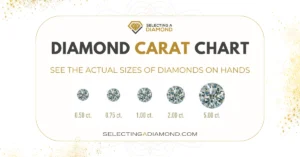
For the numbers behind the milestones, see our 1 carat diamond price breakdown and the diamond pricing guide to what a diamond is worth. If you want to know how the weight reads on a finger, our guide to how big a 1 carat diamond is shows it on real hands.
Here is the exercise we run with readers: sort by carat in the loose diamond search, then put a 0.90ct next to a 1.00ct at the same color, clarity, and cut. Look at the two videos, then look at the two prices.
What Diamond Shape Should You Buy?
The shape she already wants. Shape is preference, not quality, and it is the one decision she will look at every single day for decades. With no hints to work from, the round brilliant is the safe default, because it returns more light than any other shape. Round also costs the most per carat.
Most women have a clear idea long before a ring appears, and most of them drop hints. If the hints are going over your head, ask a friend of hers or a sister.
Shape is one of those things that is out in the open, unlike clarity or color; you cannot quietly get it wrong and hope nobody looks.
Remember this: with all other Cs equal, round diamonds carry a premium over fancy shapes. If the budget is tight and she has not signalled round, an oval or a cushion buys noticeably more spread for the same money.
Our guide to the most popular diamond shapes covers the ten mainstream outlines, and which shape is best for brilliance explains why round wins on light return. When you get to mounting the stone, feel free to browse Blue Nile’s engagement ring settings to see how each shape sits in a solitaire versus a halo.
Diamond Color: How Far Down the Scale You Can Go
H, for most buyers. In white gold or platinum, an H faces up white, and the jump to G costs real money for a difference your eye cannot catch. In yellow or rose gold, J is plenty, because the metal warms the stone anyway. Colorless D to F is a luxury, not a requirement.
Between color and clarity, color is the grade that moves price faster from one step to the next. That makes it the easier place to overspend.
The setting matters more than the grade letter here. A J stone in yellow gold reads white; a G stone in a warm setting picks up tone from the metal regardless of what the report says.
Do not get sold on a color grade you will never be able to see. Our official GIA color scale page has the full range, the H color guide on whether H diamonds look yellow answers the usual worry, and the G vs H diamond color comparison settles the one-step argument with prices.
Diamond Clarity: Buy the Lowest Eye-Clean Grade
Buy the cheapest grade that is eye clean, which usually lands at SI1 and sometimes SI2 in the right stone. Nobody is putting a loupe on your ring. Anything above SI1 is money spent on inclusions that only 10x magnification will ever find, and that money does more work in cut or carat.
Walk into a local jeweler instead of buying online and you are almost guaranteed to be oversold on clarity. It is the easiest grade to frighten a buyer with, because “flawless” sounds like a promise.
Eye clean simply means no inclusion visible to the naked eye at normal viewing distance. That is the only standard that matters on a hand.
James Allen’s Virtual Loupe was the tool everyone used for this, and it was unmatched at the time. Today the same job is done inside Blue Nile’s diamond search, where you can open the video on a shortlisted SI1 and look for inclusions parked near the girdle, exactly where a prong can cover them.
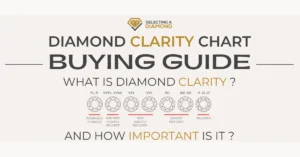
For the grade-by-grade detail, read whether SI1 is eye clean, the full diamond clarity chart from FL to I3, and which clarity grade is best value for money.
What Certification Should You Look For?
GIA first, AGS second. Both grade consistently, and their reports are the ones an appraiser or a future buyer will trust. IGI is acceptable on lab-grown stones. Avoid EGL: its grades run soft by two grades or more, so an EGL stone that looks like a bargain is usually just overgraded paper.
A grading report is not decoration. It is the only independent statement of what you are buying, and it is what makes an online purchase safe.
Check the report number against the lab’s own database before you pay, not after. It takes about thirty seconds.
Our guide on how to verify and look up a GIA report shows the steps, the grading labs review compares them side by side, and the EGL vs GIA comparison explains why we say NOT to buy EGL.
What Doesn’t Matter as Much as You Think
Fluorescence, the last step of polish and symmetry, and the top clarity grades. Medium blue fluorescence is invisible in most stones and frequently prices lower. Very Good polish and symmetry on an Excellent-cut diamond changes nothing you can see. None of these three shows on a hand at arm’s length.
They are real distinctions. They are simply not distinctions your eye is equipped to make at the price points most readers are shopping.
The one exception is strong fluorescence in a very high color stone, where a hazy look can appear in a small minority of diamonds. Watch the video, and if it looks milky, move on.
More on each: is fluorescence good or bad, what diamond polish does to price, how symmetry grades affect sparkle, and whether triple excellent GIA XXX diamonds are worth it.
Loose Diamond vs. Preset Ring: Where the Value Sits
Loose gives you control, preset gives you speed. Buying the stone on its own shows you exactly what the diamond costs and exactly what the metal costs, so you can trade one against the other. A preset ring makes sense for smaller center stones and for deadlines you cannot move.
There is a second reason to go loose, and it is resale. A certified center stone holds its identity; a fashion setting does not.
If that side of things concerns you, read our honest take on how much value a diamond loses after purchase before you decide how much to put into the setting.
One more note on the small stones around the center: they are graded and priced in parcels, not individually. Our page on melee diamonds worth and pricing explains what those accents are actually adding to the bill.
Buying Loose Diamonds Online: The 5 Checks We Run
Five checks, in this order: cut grade, grading report, video at full zoom, table and depth percentages, and the store’s current return terms. Run all five on every stone that reaches your shortlist. Four of them take under a minute each, and together they are what separates a good buy from an expensive lesson.
1. Lock the Cut Grade First
Set the filter to Excellent or Ideal before you touch any other slider. Everything else on the page is a trade-off; this one is not. If a stone tempts you at Good, close the tab.
2. Read the Report, Not the Listing
The listing is marketing copy. The PDF report is the fact. Open it, confirm the shape, carat, color, clarity, and cut all match what the product page claims, then verify the number on the lab’s site.
3. Watch the Video at Full Zoom
Play the 360-degree video and stop it face-up. Look for a dark centre, a milky wash, or an inclusion sitting under the table where no prong can reach. If the stone looks flat on video, it will look flat on a finger.
4. Check Table and Depth Percentages
Two stones with the same cut grade can still differ in spread. A table and depth combination in the accepted range for the shape is what makes a 1.00ct look like a 1.00ct. Our guide to the best table and depth percentages gives the target ranges per shape.
5. Confirm the Return Terms Before You Pay
Read the retailer’s current return and shipping policy on the day you buy, since terms change and we will not quote a window that may be out of date. A stone you can send back is a stone you can safely buy unseen.
Summary: Final Words on Buying Loose Diamonds
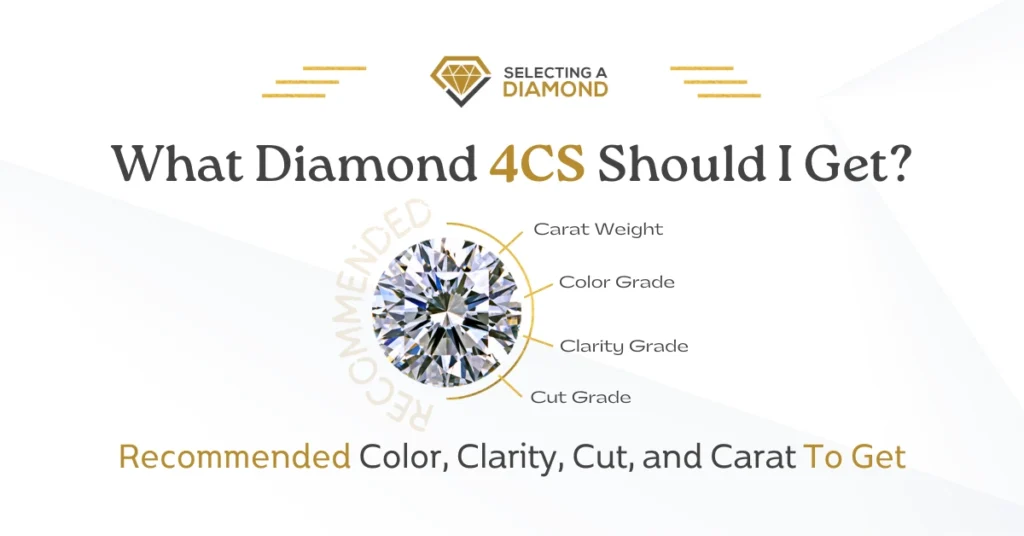
Cut, then carat, then color, then clarity. That order is the whole article compressed into four words, and following it is what produces a stone that outperforms its price tag.
Excellent or Ideal cut, H color, SI1 clarity, GIA or AGS paper. From there, put every remaining dollar into weight.
In twelve years of comparing stones for readers, we have found that the diamonds people regret are almost never the ones with a modest color grade. They are the ones bought heavy and cut badly.
Remember, each stone is unique, and the cut is what lets it show that.
Frequently Asked Questions on Buying Loose Diamonds
What are the best 4Cs to look for on a limited budget?
Excellent or Ideal cut, H color, SI1 clarity, and whatever carat weight the remaining budget allows. That combination sits right at the edge of what the naked eye can detect, so every grade above it costs money for an improvement nobody at the dinner table will ever notice.
Is it cheaper to buy a loose diamond and set it separately?
Usually yes, and more importantly it is clearer. Buying loose shows you the price of the stone and the price of the setting as two separate numbers, which lets you shift money between them. A preset ring gives you one figure and no way to tell where it went.
What clarity grade counts as eye clean?
SI1 is eye clean in most stones, and SI2 is eye clean in some, depending on where the inclusions sit and how big the stone is. Eye clean means no inclusion visible to the naked eye at normal viewing distance. Check the video before you decide, not the grade letter.
Does an H color diamond look yellow?
No, not face-up in a white gold or platinum setting. H sits in the near-colorless range and reads white to the eye once the stone is mounted and returning light. In yellow or rose gold, you can drop as low as J and still see a white stone against warm metal.
Is a Very Good cut good enough?
It is the floor, and we recommend it in rare cases only. A Very Good stone can look fine, but it gives up light return you paid for in carat weight. If the choice is a Very Good 1.00ct or an Excellent 0.90ct at the same price, take the Excellent.
Do I need a GIA certificate to buy a loose diamond?
You need a report from GIA or AGS on a natural diamond, and IGI is acceptable on lab-grown stones. Those labs grade consistently enough that the letters on the page mean what they say. An EGL report is not a bargain; it is usually the same stone described two grades too generously.
What diamond size should I buy for an engagement ring?
Buy the largest weight left over after you have secured an Excellent cut, and shop just under the round-number milestones. A 0.90ct costs meaningfully less than a 1.00ct and looks nearly identical on a finger. Size is the one thing people notice, so it deserves the leftover money, not the first money.
Still not sure where to buy your diamond?
Start with our comparison of the best places for buying diamonds online, and read our Blue Nile diamonds and jewelry review if you want to know how the store actually performs on price and service.
When you are ready to shortlist stones, feel free to run your own filters in Blue Nile’s loose diamond search using the grades above.