We may earn a commission when you purchase through our affiliate links, at no extra cost to you. This helps support our work and allows us to continue providing unbiased, expert diamond advice.
Note: Most prices, product details, or comparisons mentioned in this article are based on information available from our trusted partner we frequently reference: Blue Nile. We may earn a commission when you purchase through our affiliate links, at no extra cost to you. This helps support our work and allows us to continue providing unbiased, expert diamond advice.
Summary in a few lines:
- $30,000 is four to six times the US average engagement ring spend of $5,000 to $7,000, and around seven times the typical Canadian or UK figure of about $4,000
- At this budget you are shopping a 2 to 3 carat center stone, not a 1 carat one, plus a platinum or 18K designer setting under it
- In twelve years of pricing stones for readers, we’ve found the cut grade is what decides whether a $30,000 ring actually looks like $30,000
- Past roughly VS2 clarity and G color, the extra thousands buy paperwork, not visible beauty
- A ring at this level needs insurance and a written return policy before it needs another half carat
Table of Contents / Toggle
Is $30,000 a Lot for an Engagement Ring?
Yes. $30,000 is four to six times the US average engagement ring spend of $5,000 to $7,000, and around seven times the typical Canadian or UK figure of about $4,000. It is a lot of money by any normal measure. It is also enough to put a 2 to 3 carat center stone with premium grades on her hand.
What $30,000 is not, is automatically better. A ring bought badly at this price can read smaller and duller than a $12,000 ring bought well, because the money gets poured into grades that nobody standing across a table can see.
In twelve years of pricing stones for readers, we’ve found the same mistake repeating itself at the top of the market: buyers pay up for clarity and color, then quietly accept a softer cut grade to protect the carat weight.
That ring? It underperforms its receipt.
If you want a feel for the range before going further, feel free to browse the loose diamond search on Blue Nile and sort by price from the top down.
What Does a $30,000 Engagement Ring Look Like?
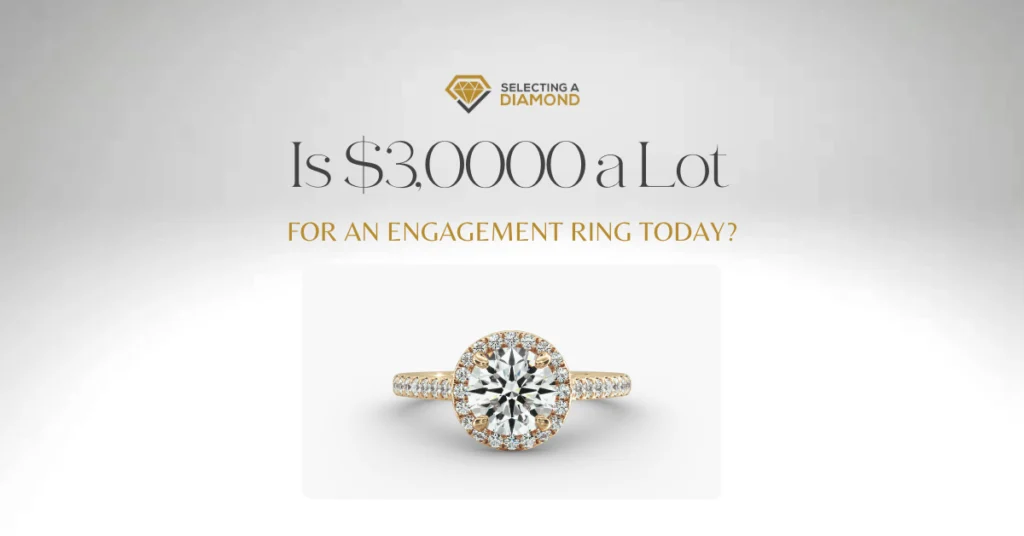
It looks like a 2 to 3 carat center diamond sitting on platinum or 18K gold, in a pavé, halo, three-stone, or hand-engraved vintage setting. The stone eats most of the budget. The grades that come with it depend on the shape you pick and on how hard you refuse to compromise the cut.
A flawless or near-flawless diamond costs more than one carrying inclusions. The same goes for a truly colorless stone compared with one holding a faint warm tint.
So the trade is always the same, and it is always three-way: size, purity, sparkle. Pick the one you care about, then let the other two settle where the money allows.
Our position has not moved in over a decade. Protect the cut, protect the shape, and treat clarity as a budget lever; if you want the reasoning laid out grade by grade, feel free to read what diamond clarity grade is best value for money.
This is not the price range for someone browsing in a mall. It’s where people shop when they want something rare, high-quality, and often one-of-a-kind.
How Does $30,000 Compare to the Average Spend?
It sits far above it. The US average engagement ring spend lands somewhere between $5,000 and $7,000, which makes $30,000 four to six times what most couples pay. In Canada and the UK the average is closer to $4,000, so the multiple there is bigger still. Common? No. Unheard of? Also no.
In other parts of the world, cultural practice and purchasing power move the average around, but $30,000 is nearly always on the high end wherever you stand.
The number climbs among high earners, second-time buyers, and people who simply value jewelry more than they value cars or holidays.
Fact: the “two months’ salary” idea people still quote at each other was an advertising line, not a rule. We took it apart in our guide to how much to spend on an engagement ring.
Price Drivers: What Pushes a Ring Toward $30,000
Seven things do almost all the work: carat weight, cut, color, clarity, shape, setting and metal, and the name on the box. Certification adds a little on top. Change any one of them and the total moves, sometimes by thousands, on a stone that looks identical from a normal viewing distance.
1. Carat Weight
Larger diamonds cost more, and the price curve is not linear. A 2 carat is not double a 1 carat; it is usually far more than double, because rough of that size is scarcer.
Weight also jumps at the round numbers. Stones sold just under a magic weight cost less than those just over it, for a size difference the eye cannot register.
2. Cut
Cut is the one grade that changes what you see. It governs how much light comes back out of the top of the stone, which is the entire reason a diamond looks like a diamond.
Pay for it first. If you want the grade scale explained properly, our guide covers how cut affects brilliance with side-by-side stones.
3. Color and Clarity
Both are rarity scales, and both are priced as rarity rather than as beauty. A D color, FL clarity stone commands a serious premium over a G color, VS2 stone of the same weight.
At arm’s length, in a restaurant, on a moving hand, that premium is invisible.
4. Shape
Round diamonds are the most expensive per carat, every time. Oval, cushion, and pear usually cost less for the same weight, which is why fancy shapes stretch a big budget further.
Shape also changes apparent size, since elongated outlines cover more finger per carat. Our breakdown of the best diamond shape for an engagement ring goes through the trade-offs.
5. Setting and Metal
Platinum is pricier than white gold, and it is heavier, denser, and slower to wear. Custom work, hand engraving, French pavé, and side stones all stack onto the total.
A setting can quietly take several thousand dollars of a $30,000 budget. That is fine, as long as you decided it rather than discovered it. We compared the options in our guide to the best ring metal for an engagement ring.
6. Brand or Designer Name
Just like clothes or cars, the name matters. Buying from a famous designer can raise the price even when the materials and the grades are the same.
7. Certification
GIA-certified diamonds usually cost more than uncertified ones, and they should. You are paying for an independent read on the grades instead of the seller’s own opinion.
At $30,000, an uncertified stone is a hard NO. If you want to know why the lab on the report changes the value of the paper, read our comparison of which diamond grading lab is the best.
So that $30,000 is not just paying for a big shiny rock. It’s paying for a combination of quality, craftsmanship, and confidence.
And roughly a third of it, in most builds we price out, is paying for rarity the wearer will never see.
Who Spends $30,000 on an Engagement Ring?
High earners, mostly, plus people for whom the ring carries weight beyond the stone. Some are following a cultural expectation where the ring is a public marker of commitment. Some saved for years. Some are on a second engagement and want this one to look nothing like the first.
Others simply rank jewelry above the other big line items in their life, and see $30,000 the way another couple sees a kitchen renovation.
None of these reasons is right or wrong. It depends on values, priorities, and budget.
What we would push back on is one motive only: spending $30,000 because a feed told you that’s the number. Trends are not rules.
$30,000 at Blue Nile: What the Budget Actually Buys
Enough to build the whole ring yourself, stone and setting separately, in the premium band of the inventory. A budget at this level reaches specifications like a 2.20 carat fancy shape, G color, IF clarity, Ideal cut, or a 2.5 carat round with an excellent cut and VS1 clarity, then leaves room for a platinum or 18K designer setting.
Put simply, the value at this price is flexibility rather than a fixed shopping list. You can pour the entire budget into one exceptional center stone, or pull back on clarity and spend the difference on a hand-engraved vintage setting and a matching band.
Every stone comes with high-definition 360-degree viewing, so you can inspect the inclusions and the light return before you commit anything. That matters more at $30,000 than at $3,000, because at this level you are buying an individual stone, not a category.
To see how the grades and the money move against each other, feel free to browse the loose diamond search filtered to 2 carats and up, then look at the designer and vintage-inspired engagement ring settings separately so you can see what each half of the budget is doing.
James Allen used to be the other name we paired with Blue Nile for this kind of build, and its imaging was unmatched at the time. It closed in August 2026, and the collection now lives inside Blue Nile.
Is $30,000 a Lot for a Wedding Ring?
Yes, and more so than for an engagement ring. Wedding bands normally sit in the hundreds to low thousands, so $30,000 on a band is genuinely unusual. It buys a serious diamond eternity band, a heavy platinum piece, or a fully custom pair for both partners rather than a single ring.
The reason the number feels stranger here is simple. A wedding band is worn every single day, through washing up, gym sessions, and airport security trays.
So durability outranks rarity on a band. Channel and bezel settings protect stones better than delicate shared-prong work, and that decision will matter more in ten years than the color grade will.
If you are pricing both pieces at once, feel free to browse the diamond and platinum wedding band collection, and read our explainer on the difference between an engagement ring and a wedding ring before you split the budget.
The Part of a $30,000 Budget Nobody Will Ever Notice
Roughly the top slice of the color and clarity scales, plus fluorescence anxiety. Moving from G to D color, or from VS2 to Flawless, can add thousands to a 2 carat stone. Under a loupe the difference is real and gradeable. On a hand, in daylight, across a table, there is nothing to see.
Flawless sounds like a promise, and technically it is one. It’s a promise about a magnified image, not about how the ring looks at dinner.
The same goes for faint fluorescence. Buyers treat it like a defect; in most stones it does nothing you can detect without a UV lamp, which we covered in our guide asking whether diamond fluorescence is good or bad.
Now compare that with cut. Drop a 2 carat stone from Ideal to Good and the sparkle collapses, at any color grade, in any setting, in any light.
Remember this: the money you claw back from color and clarity is the money that buys you a bigger, better-cut stone. If you’re weighing the two nearest grades, our comparison of whether G or H diamond color is better shows how little separates them in the face-up view.
Emotional Value vs. Financial Logic
Both readings are honest, and they answer different questions. Emotionally, a ring is a once-in-a-lifetime object and $30,000 can be entirely proportionate to what it marks. Financially, an engagement ring is a purchase and not an asset, and it will not return what you paid for it.
Some people see the ring as a symbol and are willing to spend whatever feels meaningful. For them, $30,000 isn’t about diamonds, it’s about what the ring represents.
Others look at it practically. That money could go toward a home, the wedding itself, travel, or investments, and the ring should be beautiful without breaking anything.
Where we will be blunt is on resale. A $30,000 ring is NOT a $30,000 asset the day after you buy it, and anyone telling you otherwise is selling something; we set out the mechanics in how much value a diamond loses after purchase.
What matters more than the price is how the ring fits into your life, not just your finger. Does it feel exciting rather than stressful? Is it something your partner truly wants, or something you assume you’re expected to give?
That balance, between what it means and what it costs, is where the real value lives.
Smart Tips Before You Spend $30,000 on a Ring
Four things settle most of the risk: decide which of the 4Cs you actually care about, insist on independent certification, get the return and upgrade terms in writing, and insure the ring before it ever leaves the box. Do those and the size of the number stops being the scary part.
Know what matters most. A larger stone with modest clarity will usually beat a smaller flawless one on the hand. Decide upfront whether you are buying size, sparkle, or purity, because at $30,000 you can have two of the three comfortably.
Stick to certified diamonds. GIA or AGS, with the report number matching the stone. Nothing else belongs in this price bracket.
Ask about returns and upgrades before you pay. Read the terms yourself rather than taking a salesperson’s summary of them, and confirm what happens to a custom setting versus a loose stone.
Insure it immediately. A ring at this value is a listed item on a policy, not something a standard contents cover absorbs quietly; our walkthrough on how to insure an engagement ring covers appraisals and what the policies actually pay out.
Time the purchase if you can. Prices and promotions move through the year, and we mapped the pattern in our piece on when is the best time to buy diamonds.
Tip: you do not have to spend every cent of a $30,000 budget. Some of the best rings we’ve priced for readers came in under the ceiling because the buyer took an Ideal cut, G color, VS2 stone and put the leftover money into a setting she’d actually chosen.
Let’s put the whole decision in one place before you buy anything: our pillar guide covers the 6 things you should know before buying an engagement ring.
Summary: Final Words on Spending $30,000 on an Engagement Ring
So, is $30,000 a lot for an engagement ring? Yes, for most people it is, at four to six times the average spend. That does not make it too much.
It depends on your income, your values, and what your partner actually wants rather than what you assume she wants.
For some buyers it’s a once-in-a-lifetime gesture worth the splurge. For others it would feel like too much for one object on one finger.
If $30,000 feels right and creates no regret or pressure, then it isn’t really a lot for you. If it stretches your limits or exists mainly to be seen, then yes, it probably is.
And whatever the number, spend it in this order: cut, then shape, then carat, then clarity, then color. The best rings aren’t just expensive, they’re personal, thoughtful, and chosen with care.
Frequently Asked Questions on $30,000 Engagement Rings
Is $30,000 a lot for an engagement ring?
Yes. It is four to six times the US average spend of $5,000 to $7,000, and around seven times the typical Canadian or UK figure of about $4,000. It is a high-end budget, though a normal one among high earners.
What size diamond can you get for a 30k engagement ring?
Generally a 2 to 3 carat center stone, depending on shape and grades. Round diamonds sit at the smaller end of that range because they cost the most per carat, while oval, cushion, and pear shapes stretch the budget further.
Is a $30,000 engagement ring a good investment?
No. An engagement ring is a purchase, not an investment, and it loses a substantial share of its retail price the moment it becomes second-hand. Buy it because you want to wear it.
Is $30,000 a lot for a wedding ring?
Yes, and unusually so. Wedding bands normally cost hundreds to low thousands, so $30,000 buys a diamond eternity band, heavy platinum work, or a fully custom pair for both partners.
How much should you really spend on an engagement ring?
As much as you can pay without pressure or debt. The old salary-multiple rules came from advertising, not from any rule of thumb worth keeping, and plenty of excellent rings sit well under the average.
Should you insure a $30,000 engagement ring?
Yes, and before you wear it out of the house. A ring at this value needs to be scheduled as a named item with a current appraisal, not left to standard home contents cover.
What should you never compromise on at this budget?
The cut grade and the certification. Color and clarity are budget levers whose top grades are invisible face-up; cut is the only grade that changes how much the diamond sparkles.
Still not sure where to buy your diamond?
Start with the stone rather than the ring, and look at it in motion before you look at its report. Feel free to browse the certified loose diamond inventory at Blue Nile, or read our full Blue Nile diamonds and jewelry review first if you’d rather see our findings before you shop.