We may earn a commission when you purchase through our affiliate links, at no extra cost to you. This helps support our work and allows us to continue providing unbiased, expert diamond advice.
Note: Most prices, product details, or comparisons mentioned in this article are based on information available from our trusted partner we frequently reference: Blue Nile. We may earn a commission when you purchase through our affiliate links, at no extra cost to you. This helps support our work and allows us to continue providing unbiased, expert diamond advice.
Summary in a few lines:
- A diamond typically loses 30% to 70% of its purchase price the moment it becomes second-hand, and most of that loss happens on day one
- A $10,000 ring commonly comes back as a $3,000 to $7,000 offer, depending on the certificate, the shape and the setting
- The gap is retail markup, packaging and branding, none of which the next buyer pays for
- GIA-certified round brilliants at standard weights (0.50ct, 1.00ct, 2.00ct) resell fastest and closest to trade value
- Buying nearer to wholesale is the only part of this you actually control, since you cannot control demand
Table of Contents
Toggle
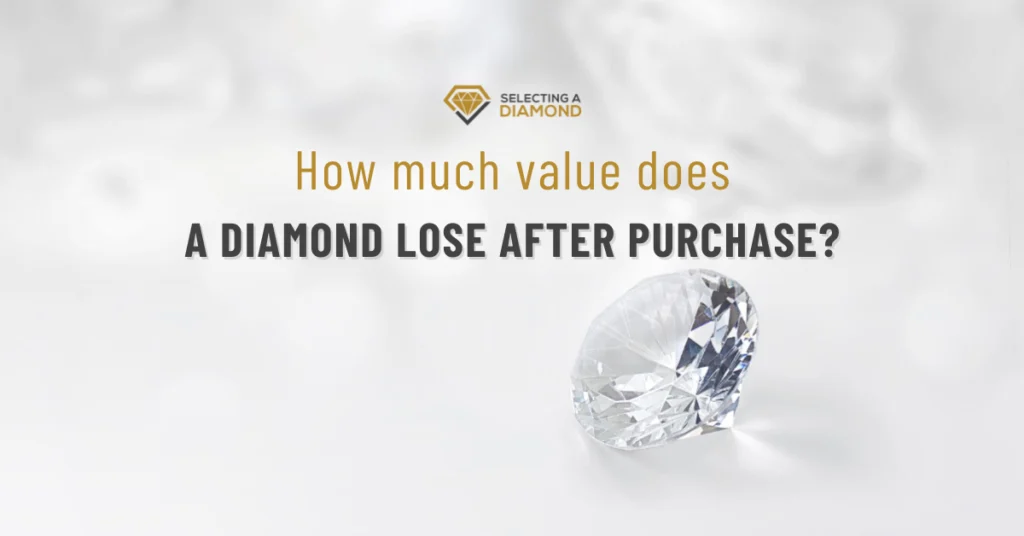
How Much Value Does a Diamond Lose After Purchase?
Expect to lose 30% to 70% of what you paid, and expect most of that drop immediately. A $10,000 ring commonly resells for $3,000 to $7,000. The gap is retail markup, not a flaw in your stone. A GIA-certified round brilliant in a plain setting sits near the top of that range.
Think of it like buying a new car. Once you drive it off the lot its value falls, even in perfect condition, and a diamond behaves the same way.
The stone has not changed at all. What changed is who is paying, and a trade buyer does NOT pay for the showroom you bought it in.
Fact: resale offers are quoted against wholesale, so two people holding identically graded stones can be quoted the same figure even though one of them paid double at retail.
In twelve years of walking readers through diamond purchases, we’ve found that this is the single biggest shock at resale time, and it has almost nothing to do with the quality of the diamond itself. So why does the number fall so far, so fast?
Why Do Diamonds Lose Value?
Because you buy at retail and sell at wholesale. The retail price carries the store’s rent, staff, advertising, packaging and profit margin, and none of that transfers to the next owner. Add shifting shape trends and custom settings that suit exactly one taste, and the resale figure lands well under your receipt.
1. Retail Markups
Part of what you pay covers overhead: advertising, salaries, insurance, store maintenance, the display case, the box. Those costs are real, and they buy you service and security at the time of purchase. They just do not carry over when you sell.
2. Wholesale Is the Real Floor
A dealer buying your diamond has to resell it at a profit, so the offer starts from trade value and works downward. Put simply, you are being quoted the price the stone would fetch between professionals, minus their margin and their risk.
3. Market Demand Moves
Demand shifts by shape, by size and by grade. A shape that everybody wanted five years ago can sit unwanted today, and a stone nobody is asking for gets a thinner offer regardless of how well it is cut.
4. Custom Designs Shrink the Buyer Pool
A one-off setting, an engraved band or an unusual halo adds to the retail cost and subtracts from the resale audience. Most buyers of second-hand jewelry are buying the stone; the design they will change anyway.
5. Perceived Quality vs. Actual Quality
A diamond can look flawless under showroom spotlights and grade a lot lower under a loupe at a desk. Second-hand buyers inspect harder than shoppers do, because they are the ones taking the risk. That is where soft grading, weak symmetry or a borderline clarity call gets punished.
Let’s open up that retail price tag and see what each part of it actually buys you.
Retail Pricing: What You Are Actually Paying For
Three things: the stone’s own trade value, the jeweler’s overhead and margin, and the metal plus craftsmanship of the setting. Only the first one survives into resale. Two identically graded diamonds can carry very different price tags, and the difference is usually the name printed on the box.
1. The 4Cs
Carat, cut, color and clarity set the base value of the stone, and cut carries more visual weight than the other three. A higher grade in any of them raises the price. If you want the full breakdown of how each grade moves the number, read our no-nonsense diamond pricing guide to the 4Cs.
2. Brand and Store Markup
The same specification bought at a luxury nameplate store can cost far more than at a smaller independent, and the diamond is not different. You are paying for the brand, the location and the experience. None of it appears on the grading report, and none of it appears in a resale offer.
3. Design and Setting
Metal has scrap value, craftsmanship mostly does not. Platinum and gold get weighed; the labor that shaped them gets ignored. It helps to know the going rate for the centre stone before you fall in love with the mounting, which is why we keep a page on the current 1 carat diamond price and another on diamond price per carat.
Which raises the obvious question: is there a published diamond rate you can check, the way you check gold?
Diamond Rate Today: Why There Is No Daily Price Board
There is no daily diamond rate the way there is a gold rate. Gold is a commodity sold by weight at one global price. Every diamond is a one-off, graded on four variables plus polish, symmetry and fluorescence, so it gets priced stone by stone. Trade price lists exist and move, but no public board shows today’s number.
Diamonds are quoted per carat, then multiplied by weight, and the per-carat figure jumps at the popular weights. That is why a 1.00ct costs more per carat than a 0.90ct of the same grade.
The closest thing a shopper has to a live rate is an open inventory feed with real asking prices attached. Set the filters to the exact specification you are pricing, then read the spread: feel free to browse Blue Nile’s loose diamond search and compare like for like.
Tip: price two searches, one at 0.95ct and one at 1.00ct, same color and clarity. The size difference is invisible on a hand; the price difference is not.
Lab-Grown vs. Natural Diamonds on Resale
Lab-grown diamonds lose a larger share of their purchase price than natural ones, and frequently close to all of it. Production capacity has grown fast, wholesale prices have fallen year after year, and your used stone competes against a brand new one that keeps getting cheaper. Natural diamonds lose a lot; lab-grown ones lose more.
That is not an argument against buying one. It is an argument for buying one for the size and sparkle you get today, not as a store of value.
Their value trajectory may not parallel that of natural diamonds, although they remain genuine diamonds by every physical measure. If you are weighing the two, our lab grown diamond pricing guide lays out how the numbers are set.
What Does NOT Affect Your Diamond’s Resale Value
Plenty of things buyers worry about turn out to be irrelevant at the counter. The original box, the receipt, the store’s own appraisal, the insurance valuation and the fact that you wore the ring daily for six years: none of these move the offer in any meaningful way.
The appraisal is the big one. It is written for insurance replacement, so it is deliberately high, and no dealer will pay against it.
Wear is the other one. Diamonds do not dull, fade or tire, and a professional cleaning restores almost any ring, which is a side effect of just how strong diamonds are. Chips and abraded girdles matter; ordinary daily wear does not.
And that premium you paid to move from VS1 up to VVS1? Largely invisible to the eye and largely gone at resale. Grades the market can see get paid for; grades only a loupe can see do not.
Tips to Buy a Diamond That Holds Its Value
Buy certified, buy classic, buy closer to wholesale. You cannot stop the retail-to-wholesale drop, but you can decide whether your stone lands at the 30% end of the loss or the 70% end. The three levers that matter are the grading report, the shape, and how much markup you paid on the way in.
1. Prioritize Certified Diamonds
A GIA report is the document the trade asks for first, and older AGS reports still carry weight. An uncertified stone, or one graded by a soft lab, gets discounted on sight. If certificates are new territory, start with our guide on which grading lab is the best.
2. Opt for Timeless Shapes
Round brilliant is the default the second-hand market asks for, and it resells with the least friction. Princess and oval hold up reasonably well. Novelty shapes are wonderful to own and slow to sell.
3. Focus on Quality Over Size
A smaller, well-cut, eye-clean stone holds value better than a bigger one with visible inclusions. Always seek an excellent or ideal cut even if it costs you a tenth of a carat. Our page on the best diamond 4Cs for affordable grades shows where to spend and where to stop.
4. Consider Resale-Friendly Settings
A clean solitaire or a simple pave band in platinum or gold appeals to almost everyone. Heavily ornate custom work appeals to one person, and you already married them. Take, for example, the classic solitaire and plain-band settings on Blue Nile, which are the styles that keep turning up in the resale market year after year.
5. Maintain the Diamond’s Condition
Store the ring so it is not knocking against other jewelry, clean it regularly, and have the prongs checked. A stone with a chipped girdle is a recut, and a recut is a real loss of weight and money.
6. Understand the Market
Standard weights sell better. Buyers ask for 0.50ct, 1.00ct, 1.50ct and 2.00ct, and they pay a premium for hitting the number exactly. A 1.48ct is a lovely diamond and a slightly awkward sale.
7. Shop Smart on the Way In
The cheapest way to lose less later is to pay less now. Online inventories run leaner than showroom floors, and the saving is yours from day one. If you want the wider view first, our pillar guide on how to pick a good diamond covers the whole process.
So who is on the other side of the table when the day comes to sell?
Who Buys a Second-Hand Diamond, and What They Pay
Four groups, and they pay very differently. Pawnshops pay the least and pay instantly. Jewelers buying outright pay a little more. Consignment through a jeweler or an online resale platform pays better and takes months. A private buyer pays the most and is the hardest to find.
Speed costs money. Every step up in price is a step down in convenience, and that trade-off is the whole decision.
Get two or three offers before accepting one, because the spread between channels on the same stone can be wide. We’ve laid out the process, paperwork and realistic expectations in our guide on how to sell an engagement ring.
Are Diamonds an Investment?
No, not in the way a stock or a gold bar is. There is no liquid market, no daily quote and no guaranteed buyer, and you pay a large retail spread on entry. Diamonds are a durable luxury purchase that happens to retain some resale value. Buy one because you want to wear it.
Rare stones do appreciate. Fancy colored diamonds at the top of the market, exceptional large stones, historic pieces: these behave like art, and they are not what most people are buying.
We consider this, how can we say it, the least fun fact in diamond buying. But knowing it up front is what stops a nasty surprise later.
Remember, a diamond’s job is to look extraordinary on a hand for decades. Judge the purchase on that, and treat any resale money as a bonus.
Summary: Final Words on Diamond Value After Purchase
1. Diamonds lose value the moment they leave the store. On average 30% to 70%, driven by retail markup and wholesale resale pricing.
2. Certification decides where you land in that range. A GIA report makes the stone easy to price and easy to sell.
3. Timeless shapes resell. Round brilliant first, then princess and oval; novelty shapes sit.
4. Quality beats size. A smaller eye-clean stone with an excellent cut outperforms a bigger flawed one, at purchase and at resale.
5. The box, the receipt and the appraisal are worth nothing at resale. Do NOT count on them.
6. Paying less at the start is the only loss you fully control. Buy closer to trade price and the drop hurts far less.
Frequently Asked Questions on Diamond Value After Purchase
Why do diamonds lose value?
Because you buy at retail and sell at wholesale. The retail price includes the store’s rent, staff, advertising, packaging and profit, and a trade buyer pays for none of that. Shape trends and custom settings widen the gap further.
How much value does a diamond lose after purchase?
Typically 30% to 70% of the purchase price. A $10,000 ring commonly attracts offers between $3,000 and $7,000, with GIA-certified round brilliants in plain settings landing at the higher end.
Does a diamond lose value immediately?
Yes. Most of the loss happens the moment the ring becomes second-hand, not gradually over years. The stone has not changed; the buyer has.
Is there a diamond rate today, like a gold rate?
No. Gold is a commodity with one global price per gram, while every diamond is graded individually and priced per carat according to its own combination of cut, color, clarity and weight. Trade price lists move, but no public daily board exists.
Do all diamonds lose value, or do some hold it?
Almost all lose value at resale. The exceptions are rare fancy colored diamonds, exceptional large stones and historic pieces, which behave more like collectible art than jewelry.
Do lab-grown diamonds lose more value than natural diamonds?
Yes, generally more, and often close to all of it. Lab-grown wholesale prices have kept falling as production grew, so a used stone competes with a cheaper new one.
Does wearing my diamond reduce its value?
Not in any normal sense. Diamonds do not dull or fade, and cleaning restores the look. Chips, abraded girdles and damaged prongs do reduce value, so have the setting checked periodically.
Still not sure where to buy your diamond?
The less markup you pay on the way in, the smaller the drop on the way out, so start by pricing the exact specification you want against an open inventory. If interested, browse Blue Nile’s diamond and jewelry collection, or read our comparison of the best places for buying diamonds online first.