
We may earn a commission when you purchase through our affiliate links, at no extra cost to you. This helps support our work and allows us to continue providing unbiased, expert diamond advice.
Note: Most prices, product details, or comparisons mentioned in this article are based on information available from our trusted partner we frequently reference: Blue Nile. We may earn a commission when you purchase through our affiliate links, at no extra cost to you. This helps support our work and allows us to continue providing unbiased, expert diamond advice.
Summary in a few lines:
- 10k gold is 41.7% pure gold, 14k gold is 58.3%. Every other difference comes out of that one number
- 10k is the harder, more scratch-resistant metal, and the cheaper one: roughly $43.35 per gram against $60.69 for 14k at April 2025 market prices
- 14k carries more gold, shows a warmer yellow, and holds 41.7% alloy instead of 58.3%, which makes it the safer pick for sensitive skin
- The color gap between the two is real but small; you need the two pieces touching to call it
- Fine jewelry runs on 14k and 18k. In 12 years of shopping settings for readers, we’ve found 10k almost never appears in an online retailer’s metal menu
Table of Contents / Toggle
What’s the Difference Between 10k and 14k Gold?
10k gold is 41.7% pure gold. 14k gold is 58.3%. That single figure drives the rest: 14k looks warmer and costs roughly 40% more per gram, while 10k is harder, shrugs off scratches better, and sells for less. Both are real gold, both are legally sold as gold in the US, and both are stamped.
Gold on its own is too soft for jewelry that gets worn. So it’s mixed, alloyed, with copper, silver, zinc, and sometimes nickel.
The alloy is what buys you strength. It also drains the color, which is exactly why 10k reads paler than 14k when the two sit side by side.
Let’s take each karat on its own terms, then put them head to head.
The “K” in Gold: Karat vs Carat
Karat measures gold purity out of 24 parts. Carat measures gemstone weight. So 10k means 10 parts gold to 14 parts other metals, and 14k means 14 parts gold to 10 parts alloy. Two words that sound identical, two completely unrelated measurements: a 14k ring can hold a 1-carat diamond with no contradiction at all.
24k is 100% pure gold, and nobody sensible builds an everyday ring out of it. It bends, dents, and loses its shape.
If it’s stone color you came for rather than metal color, our guide to the official GIA diamond color chart handles that side of the decision.
10k Gold Explained: Tough, Pale and Cheaper
10k gold is 10 parts pure gold to 14 parts alloy, or 41.7% gold. It is the hardest of the common jewelry golds and the cheapest by weight. It is also the palest yellow of the two, and the more likely to irritate skin, because more than half of what you’re wearing is not gold.
That hardness is a genuine advantage. A 10k band takes desk dings, car keys, and gym equipment with less visible damage than a softer alloy.
It’s the honest budget option too. You get real, stamped, solid gold rather than a plated base metal that wears through in a year.
Fact: 10k is the legal floor in the United States. Below that, a piece cannot be described as “gold” at all.
The trade-off is the look. Next to a 14k piece, 10k can read slightly washed out, almost whitish in the yellow.
14k Gold Explained: The Industry Default
14k gold is 14 parts pure gold to 10 parts alloy, or 58.3% gold. It is the standard metal of fine jewelry in the US, and for one reason: it holds enough gold to look properly warm, while keeping enough alloy to grip a diamond securely for decades of daily wear.
It’s also the karat most engagement rings and wedding bands are built in. Prongs made in 14k bend when a jeweler wants them to bend, and stay put when they don’t.
In twelve years of pricing settings for readers, we’ve found that the metal menu on a serious online retailer runs 14k, 18k, platinum, and stops there. Feel free to open the metal choices on Blue Nile’s engagement ring settings and count how many 10k options you find.
10k vs 14k Gold: Side-by-Side on What Matters
Five things separate them: gold content, hardness, color, price per gram, and scrap value. 14k wins on purity, color, and resale weight. 10k wins on hardness and price. Nothing else about the two metals differs in a way you will notice across a dinner table.
1. Gold Content
10k holds 41.7% pure gold and 58.3% other metals. 14k flips that: 58.3% gold, 41.7% other metals. That’s the entire technical difference between the two, and everything below is a consequence of it.
2. Durability
10k is harder and more scratch-resistant, because alloy metals are harder than gold. 14k is a little softer, and still tough enough for a ring worn every single day. Neither one is fragile, and neither one is scratch-proof.
3. Color
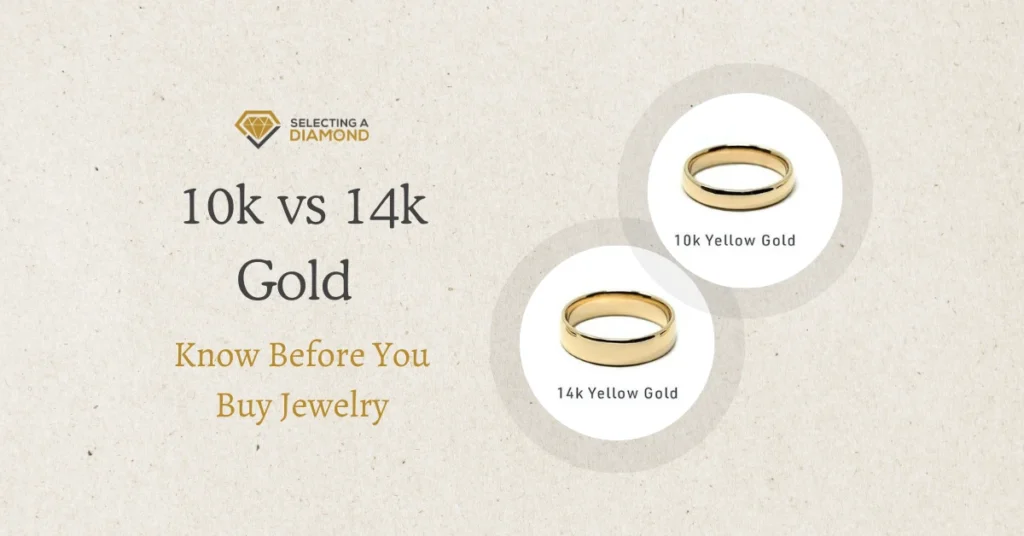
14k shows a deeper, warmer yellow that sits closer to what people picture when they hear “gold.” 10k is lighter and cooler in tone. The difference is subtle rather than dramatic, and it grows the longer you stare at the two together.
4. Price Per Gram
At market prices from April 12, 2025, 10k ran about $43.35 per gram and 14k about $60.69. Notice how neatly that tracks the gold content: 58.3 divided by 41.7 is 1.40, and 60.69 divided by 43.35 is also about 1.40. You are paying for gold, not for prestige.
5. Resale Value
A 14k piece carries more gold per gram, so it scraps for more than an identical 10k piece. That said, gold spot prices move constantly, and no finished piece of jewelry resells anywhere near its retail ticket. If that number matters to you, our breakdown of how much value a diamond loses after purchase sets realistic expectations.
How Big Is the Color Difference in Yellow Gold?
Small. With the two pieces touching, 14k yellow reads warmer and richer while 10k looks paler and slightly whitish. Apart, on two different hands, in ordinary indoor light, almost nobody calls it correctly. Finish, polish, and the stones set around the metal shift perceived color more than the karat does.
So this is a real difference that mostly does NOT decide anything. Unless you’re stacking a new band against an existing 14k ring, nobody is running a color audit on your finger.
Where it does matter is matching. A 10k band worn beside a 14k engagement ring can look mismatched in strong daylight. Buy both in the same karat and the problem disappears.
Skin tone is worth a thought too. Warm undertones tend to flatter the deeper 14k yellow, while cool or neutral undertones often carry the lighter 10k shade comfortably.
Remember this: hold the piece against your own wrist in daylight before you decide. Your eyes beat any chart.
Gold Stamps Decoded: 417, 585, 10ct and 14ct
417 means 41.7% gold, which is 10k. 585 means 58.3% gold, which is 14k. Pieces from the UK and Australia are marked in “ct” instead, so 10ct and 14ct mean exactly what 10k and 14k mean. British jewelry more often starts at 9ct, stamped 375, which sits just below 10k in purity.
The stamp lives somewhere discreet. Inside a ring shank, on a necklace clasp tab, or on the post of an earring.
No stamp at all is a warning sign, not a bargain. Plated pieces often carry marks like GP, GF, or HGE instead, and those are not solid gold.
Tip: a 585 stamp tells you the purity of the metal and nothing whatsoever about the quality of the stone sitting on top of it. Those are two separate purchases in one piece.
Which Is Better for Everyday Wear?
10k is better if your hands take a beating: trades, gardening, gym work, a ring that never comes off. 14k is better for almost everyone else, and it is still perfectly strong for daily wear. Both survive normal life; 10k just hides the evidence slightly better.
Want something you never have to think about? Go 10k.
Want a balance of color, comfort and toughness? Go 14k.
One caveat on “tougher.” Harder metal resists scratches, but it also has less give, so a hard knock is more likely to crack a 10k band than bend it.
Either karat holds its shine with basic care. Our guide on how to clean your diamond ring at home covers what to use and what will quietly wreck the finish.
Allergies and Skin Sensitivity: Which Gold Is Gentler?
14k is gentler. Pure gold almost never triggers a reaction, and 14k contains 58.3% of it against 10k’s 41.7%. The culprit is usually nickel in the alloy, so the karat with less alloy gives your skin less to argue with. Neither one is automatically nickel-free.
If you’ve reacted to jewelry before, ask specifically for nickel-free alloy rather than simply going up a karat. Reputable retailers list the alloy composition, and the ones that won’t tell you are telling you something.
Earrings are the strictest case, since the metal sits inside broken skin all day. Feel free to look through the 14k and 18k gold earrings on Blue Nile if sensitivity is your deciding factor, and if you’re sizing studs, our guide to the best size for diamond stud earrings pairs with it.
Popular Jewelry Types by Karat
Both karats are made into every kind of jewelry, but the sensible split is simple. 10k earns its place in knock-about pieces worn constantly: casual bands, chains, everyday bracelets. 14k belongs on anything meaningful, anything holding a diamond, and anything touching sensitive skin for hours at a time.
1. Rings
10k suits casual bands, promise rings, and any ring that lives on a working hand. Engagement rings and wedding bands are a different job. They hold stones, they get resized, and they’re meant to last a lifetime, which is why 14k dominates there.
If you’re still weighing gold against platinum, our comparison of the best ring metal to choose for your engagement ring runs through all of them. For band shapes and profiles, browse the 14k gold wedding rings and check what karat each one is offered in.
2. Earrings
Either karat works mechanically. For pierced ears, 14k is the safer bet, purely because there’s less alloy in contact with skin.
3. Necklaces and Pendants
A chain worn every day and slept in is a good argument for 10k, since links are where wear shows first. Dressier pendants taken off at night do well in 14k, where the warmer color pulls its weight.
4. Bracelets
Bracelets take more abuse than any other category. They hit desks, doorframes, and steering wheels all day. 10k handles that abuse well. For a gift piece with a bit more presence, feel free to browse the 14k gold bracelets collection and compare weights.
White Gold and Rose Gold in 10k vs 14k
Karat measures gold content, not color. Both 10k and 14k come in yellow, white, and rose, because the alloy recipe changes the color while the purity stays fixed. White gold in either karat is rhodium-plated, and that plating wears off on a schedule that has nothing to do with karat.
Under the plating, 10k white gold starts out slightly whiter, simply because there’s less yellow gold in the mix. Once both are plated, they look identical.
Rose gold gets its blush from copper. With more room for alloy, 10k rose can come out noticeably redder than 14k rose. Some people prefer that, and it’s worth seeing in person.
Resizing, Repairs and Long-Term Care
14k is the easier metal to work on. It solders cleanly, resizes predictably, and takes prong retipping without drama. 10k is harder and less forgiving at the bench, so some jewelers charge more for it or decline the job outright, and a cracked 10k shank can be a genuine repair headache.
That’s not a reason to avoid 10k. It is a reason to buy 10k in the right size the first time.
If a resize is already on your mind, our guide on whether an engagement ring can be resized explains which designs move and which don’t.
Jeweler Stock: Why 14k Dominates the Case
14k dominates because it satisfies the most buyers at once: enough gold for a proper warm color, enough alloy for durability, enough purity for sensitive skin, and a price well under 18k. 10k mostly turns up in chain-store casual jewelry, where the priority is the lowest possible ticket on solid gold.
Simply put, retailers stocking pieces meant to last decades standardise on 14k and 18k. James Allen ran the same way before the brand was folded into Blue Nile, and Blue Nile’s own settings follow the same pattern today.
That is a signal, not a rule. If your budget puts a 10k chain in reach and a 14k one out of it, buy the 10k chain and wear it: real gold at 41.7% beats plated brass every day of the week.
Summary: Final Words on 10k vs 14k Gold
There’s no universal winner here. There’s the karat that fits your hands, your skin, and your budget.
10k is tougher, cheaper, and paler. It’s the smart pick for casual rings, everyday chains, and bracelets that get knocked around.
14k holds 58.3% gold, looks richer, sits better on sensitive skin, and repairs more easily. For a wedding band, an engagement ring, or a gift meant to outlive the occasion, it’s the standard for good reason.
And the color difference everyone worries about? Buy the karat that suits the job, and nobody will ever ask which one you chose.
Frequently Asked Questions on 10k vs 14k Gold
What is the difference between 10k and 14k gold?
10k gold is 41.7% pure gold mixed with 58.3% other metals, while 14k gold is 58.3% pure gold mixed with 41.7% other metals. The extra gold in 14k makes it warmer in color, more expensive per gram, and gentler on sensitive skin. The extra alloy in 10k makes it harder and more scratch-resistant.
Is 10k or 14k gold better for a ring?
14k is better for an engagement ring or wedding band, because it holds stones securely, resizes cleanly, and shows a richer yellow. 10k is the better choice for a casual band on a hand that takes daily abuse, since it resists scratches more effectively. Both are solid gold and both last.
Can you see the color difference between 10k and 14k yellow gold?
Side by side and touching, yes. 14k reads warmer and deeper, 10k reads paler and slightly cooler. On two separate hands in ordinary light, almost nobody spots it. The difference only becomes a practical issue when you’re matching a new piece to gold you already own.
Is 10k gold real gold?
Yes. 10k is 41.7% pure gold and it is the legal minimum purity that can be sold as gold in the United States. It is stamped 417, it is solid rather than plated, and it will never wear through to a base metal underneath.
Which is more expensive, 10k or 14k gold?
14k costs more, and the gap tracks the gold content almost exactly. At April 2025 market prices, 10k ran about $43.35 per gram against about $60.69 for 14k, roughly 40% more, which is the same ratio as 58.3% gold to 41.7% gold.
Does 10ct gold mean the same as 10k gold?
Yes. “ct” is the British and Australian way of writing karat for metal purity, so 10ct and 14ct mean 41.7% and 58.3% gold respectively. UK jewelry more commonly starts at 9ct, stamped 375, so 10ct pieces are relatively rare there.
Does 10k gold tarnish or discolor skin?
Solid gold doesn’t rust, but the copper and silver in the alloy can react with sweat, lotions and chlorine. Since 10k holds more of those metals, it discolors and leaves marks on skin slightly more often than 14k. A soft cloth and a gentle cleaning routine handle it.
Still not sure where to buy your diamond?
Pick the karat first, then the stone. The metal is the cheaper half of the decision. If you want to compare settings and stones in one place, feel free to run a filtered search through Blue Nile’s loose diamond inventory, and read our full Blue Nile diamonds and jewelry review before you commit.