We may earn a commission when you purchase through our affiliate links, at no extra cost to you. This helps support our work and allows us to continue providing unbiased, expert diamond advice.
Note: Most prices, product details, or comparisons mentioned in this article are based on information available from our trusted partner we frequently reference: Blue Nile. We may earn a commission when you purchase through our affiliate links, at no extra cost to you. This helps support our work and allows us to continue providing unbiased, expert diamond advice.
Summary in a few lines:
- A straight, flat band is the safest match for an emerald cut, because the stone is built from straight lines and the band repeats them
- Curved and contoured bands exist for one reason: to close the gap under a high-set basket or a halo mounting
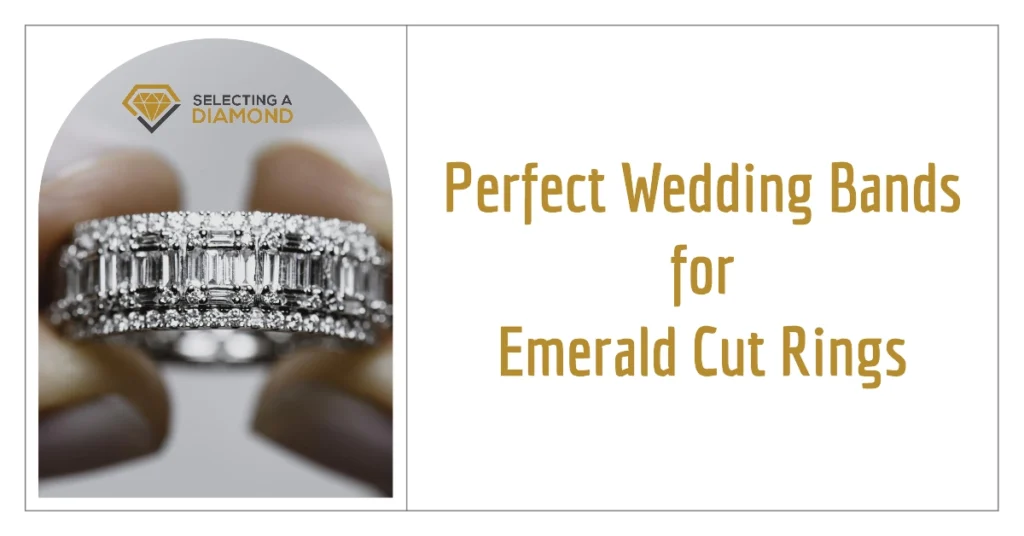
- Baguette bands are step cut, exactly like your center stone, which makes them the only accent shape that faceting-matches an emerald
- A gap of about a millimetre is invisible at arm’s length, so do not rebuild your whole stack chasing it
- Mixed metals are a style decision and not an error, and in twelve years of pairing rings for readers we have never seen rose gold look wrong beside a platinum emerald cut
Table of Contents
Toggle
The wedding band matters as much as the engagement ring. It stays on your hand for decades, and it sits directly against a stone you already spent real money on.
An emerald cut engagement ring is a classic, elegant choice, and it is fussier about its band than almost any other shape. Let’s get the pairing right.
How Do You Choose a Wedding Band for an Emerald Cut Engagement Ring?
Start with the setting, not with the band. An emerald cut is a step cut with long straight facets and a clean rectangular outline, so bands built on straight lines sit against it best. A plain solitaire mounting takes a flat band with no shaping at all. A high basket, a halo, or an east-west mounting usually needs a contoured band to sit flush.
Width comes second. Keep the band at or under the width of the engagement ring’s shank, because a band that outmuscles the shank makes the center stone read smaller than it is.
Metal comes third, and it matters less than most buyers fear. Matching metals give you one continuous look; a deliberate contrast reads as a decision, not a mistake. If you are still choosing, our guide to the best ring metal to choose for your engagement ring covers the trade-offs.
Accents come last: diamonds, baguettes, colored stones, or nothing at all.
In twelve years of putting bands next to center stones for readers, we’ve found the fastest way to settle this is to see the profiles side by side rather than one at a time. Feel free to browse the straight and curved wedding bands at Blue Nile before you fall in love with a single design.
The Wedding Band Gap: When It Shows and When It Doesn’t
A gap appears when the engagement ring’s mounting flares at the base or sits higher than the band beneath it. With an emerald cut, the culprit is almost always a high basket or a halo, not the stone itself. A curved or contoured band closes it completely. A millimetre of daylight, on the other hand, is invisible at arm’s length.
Nobody sees your rings from six inches away except you. That is worth remembering before you rule out three quarters of the market.
Remember this: deciding you don’t mind a small gap doubles your options instantly, because every straight band on the planet comes back into play.
If you want zero daylight, you have two routes: a contoured band shaped to your ring’s outline, or a custom notched band. Both cost more than a straight one, and both lock you into that engagement ring forever.
What Are the Best Wedding Bands for Emerald Cut Engagement Rings?
Nine styles pair well, and three of them almost never fail: a straight diamond band, a plain flat metal band, and a baguette band. All three echo the straight geometry of the step cut. Curved, channel set, pavé, milgrain, colored gemstone and mixed metal bands work too, each with one condition attached.
1. Straight Diamond Band
A straight diamond band complements the clean lines of an emerald cut, and it adds the small-scale sparkle a step cut simply does not produce on its own. It sits flat against any low setting. If you buy one band and never think about it again, buy this one.
2. Plain Flat Metal Band
The most underrated choice on this list. An emerald cut is an exercise in clean geometry, and a plain flat band in the same metal keeps every eye on the stone. It is also the cheapest option here by a wide margin, and the easiest to resize later.
3. Baguette Band
Baguettes are step cut, exactly like your center stone. That makes a baguette band the only accent shape that repeats your emerald’s faceting instead of arguing with it. Before you shop one, it helps to know what a baguette diamond is and how tapered and straight baguettes differ.
4. Curved or Contoured Band
A curved band is shaped to trace the outline of the engagement ring, so the two sit as one piece with no visible gap. It is the standard answer for halo and high-set emerald cuts. James Allen’s contoured selection was one of the deepest in the market at the time; the brand closed in August 2026 and now exists as a collection inside Blue Nile.
5. Channel Set Band
Diamonds sit inside a channel, flush with the metal, with no prongs standing proud. That gives you a sleek modern line and nothing to snag on clothing or hair. It is the practical pick for hands that work.
6. Pavé Band
A pavé band is covered in small diamonds across its surface, and the continuous shimmer makes a rich, luxurious pairing. One honest caution: a very busy pavé band can make a step cut look flat by contrast, especially if the engagement ring is already a halo.
7. Vintage or Milgrain Band
Milgrain beading and vintage detailing add romance, and they suit emerald cuts because the shape itself is an Art Deco signature. Match it to a vintage-style mounting. Next to a stark modern solitaire, the two styles can pull in opposite directions.
8. Colored Gemstone Band
Sapphires or emeralds set into the band introduce color and make the stack unmistakably yours. It is the choice for people who want to step off the traditional path. Our roundup of blue sapphire wedding rings shows how the pairing looks in practice.
9. Mixed Metal Band
Pairing a platinum or white gold engagement ring with a rose or yellow gold band creates contrast on the finger and reads as intentional, not accidental. Just keep the widths matched so the contrast stays about color.
Matching Metal and Width: Getting the Proportions Right
Match the metal if you want the two rings to read as one piece, and contrast it deliberately if you want them to read as two. On width, keep the band equal to or narrower than the engagement ring’s shank. A band that is wider than the shank shrinks an emerald cut visually, which is the opposite of what anyone paid for.
Karat matters for wear, not for looks. A softer, higher-karat band rubbing against a harder shank all day will lose metal faster, so our guide comparing 10k vs 14k gold is worth two minutes before you order.
Tip: platinum and rhodium-plated white gold look identical on day one, but they wear differently over years of contact. Pick one metal for both rings where you can.
Should Your Wedding Band Have Diamonds or Stay Plain?
Either works, and this one is genuinely preference rather than rule. Diamonds on the band supply the fast, fine sparkle that a step cut does not create by itself. A plain band keeps all the attention on the emerald’s broad flashes of light. If your engagement ring is already a halo or pavé mounting, plain is the calmer and usually better call.
Here is the part that does not matter: the clarity grade of the tiny stones on the band. At those sizes nobody, including you, will ever see the difference between VS and SI, which is exactly why melee diamonds are priced the way they are. Spend the money on the center stone instead.
What does matter is the setting quality holding those small stones, since a lost melee stone is the single most common repair on a diamond band.
Emerald Cut vs. Princess and Radiant: Why the Band Choice Differs
An emerald cut has a rectangular outline with cropped corners and long step facets, so it wants straight lines and gets nothing from a fussy band. A princess cut is square with brilliant faceting, so it tolerates far more sparkle beside it. A radiant cut sits between the two and pairs happily with almost any band shape.
Corners are the practical difference. An emerald cut’s cropped corners leave a small step in the outline, which is why contoured bands for emerald cuts are shaped differently from those cut for a square stone.
If you are shopping for a different shape, we have written the same guide for the wedding band for a princess cut engagement ring and for the wedding band for a radiant cut engagement ring.
Which Ring Goes On First?
The wedding band goes on first, closest to the heart, with the engagement ring stacked above it. That is tradition and not law, and plenty of people wear the two on separate hands or reverse the order entirely. What actually matters is that the pair sits flush and neither ring spins on the finger.
Order also affects wear. The ring underneath takes the pressure from the one above, so a delicate pavé band placed under a heavy mounting will show it first.
If you are still sorting out what each ring is for, start with the difference between engagement ring and wedding ring, then read how to wear wedding band and engagement ring together day to day.
Summary: Final Words on Wedding Bands for Emerald Cut Engagement Rings
The best wedding band for an emerald cut is the one that repeats its lines instead of competing with them. Straight, baguette, or plain flat: those three are almost impossible to get wrong.
Everything after that is setting-driven. High basket or halo, go contoured. Low solitaire, go straight and save the money.
And do not let the gap question paralyse you. It is the smallest visual issue on the ring, and worrying about it costs you three quarters of the bands you could otherwise wear.
Frequently Asked Questions on Wedding Bands for Emerald Cut Engagement Rings
What wedding band goes with an emerald cut engagement ring?
A straight band goes with an emerald cut, because the stone’s rectangular outline and step facets are all straight lines. Diamond, baguette, and plain flat versions all work. Curved bands come in only when the engagement ring is high-set or haloed and a straight band cannot sit flush against it.
What is the best wedding band for an emerald cut engagement ring?
A straight diamond band is the best all-round pick. It adds the fine sparkle a step cut lacks, it sits flat against most settings, and it matches the geometry of the center stone. A baguette band is a close second and arguably the more sophisticated choice.
Do you need a curved band with an emerald cut ring?
No, not unless your setting demands it. A low solitaire or bezel emerald cut takes a straight band with no gap at all. Curved bands are for high baskets, halos, and mountings that flare at the base.
Can you wear a round diamond band with an emerald cut engagement ring?
Yes, and it is the most common pairing sold. Round melee on the band contrasts with the step cut rather than matching it, which many people prefer. Just keep the melee small so the band supports the center stone instead of crowding it.
Should the wedding band match the engagement ring metal?
It should match if you want the two rings to read as a single piece. Mixing metals is a legitimate style choice and looks deliberate as long as the widths are similar. The one practical concern is wear, since two different metals rubbing together age at different rates.
How wide should a wedding band be for an emerald cut ring?
Equal to or narrower than the engagement ring’s shank. A band wider than the shank makes the emerald cut look smaller than its carat weight, and the whole stack starts to look bottom-heavy on the finger.
Are two bands too much with an emerald cut?
Two thin bands worn either side of the engagement ring is a classic look for emerald cuts, and it solves the gap question by framing the ring instead of hiding it. Keep both bands identical and keep them thin.
Still not sure where to buy your diamond?
Blue Nile is the store we point readers to for both halves of the set, and being able to shop the band and the center stone in one place saves a lot of guesswork about metal matching. Feel free to look through the emerald cut engagement ring settings at Blue Nile, or start from the stone with their loose diamond search and build the ring around it.
Want the long version first? Read our full Blue Nile diamonds and jewelry review.